How to Measure Recruitment Effectiveness in 2026: KPIs, APAC Benchmarks, and What AI Changes
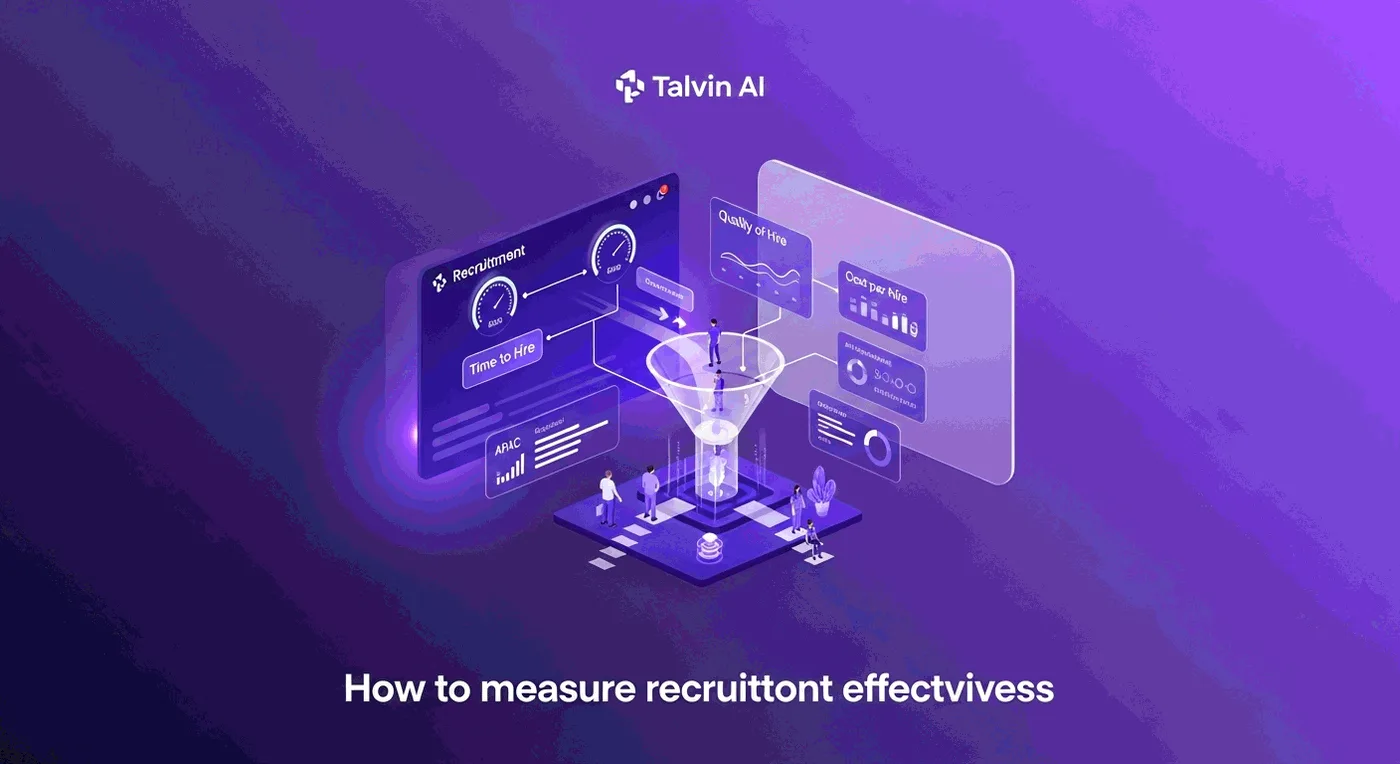
Knowing how to measure recruitment effectiveness has always mattered. In 2026, with AI tools changing what’s possible in screening timelines, candidate throughput, and quality-of-hire, the benchmarks have shifted — especially for teams hiring at volume across APAC, offshore, and BPO-heavy markets. This guide updates the core recruitment KPIs, adds APAC-specific context, and shows what good actually looks like when AI is part the process.
If you’re still measuring your recruitment function against 2022 benchmarks, you’re likely underestimating how much time and money is being left on the table.
Why Recruitment Metrics Look Different in APAC High-Volume Hiring
Most KPI frameworks were designed for Western markets with moderate hiring volumes, stable candidate pipelines, and months-long hiring cycles. They don’t account for the realities of high-volume APAC recruiting:
- Application volumes that overwhelm small TA teams — hundreds of CVs per role in markets like Sri Lanka, India, and Malaysia
- Top candidates who accept competing offers within 48–72 hours of applying
- Non-native English speaker diversity that breaks Western AI scoring tools
- BPO and offshore delivery center hiring where you may need to screen 150+ candidates per cycle
The standard advice — “track time-to-fill and cost-per-hire” — is a starting point, not a strategy. Here’s a more complete framework.
The 10 Recruitment KPIs That Actually Matter in 2026
1. Time-to-Screen (Not Just Time-to-Fill)
What it measures: How long it takes from application submission to a screened, qualified shortlist landing in a recruiter’s hands.
Time-to-fill is a lagging indicator — it tells you what happened, not where the bottleneck was. Time-to-screen is more actionable. It isolates the screening phase, which is typically where delays compound.
APAC benchmark (manual process): 4–5 weeks for high-volume roles (150+ applicants).
APAC benchmark (AI-assisted): 5 days for equivalent volume.
Janashakthi Group, a Sri Lankan conglomerate, ran a pilot using Talvin AI’s voice interview platform and screened 150 candidates in 5 days — a process that had previously taken 4–5 weeks. That compression doesn’t just save time. It means your best candidates haven’t already accepted other offers.
2. Screening-to-Interview Conversion Rate
What it measures: The percentage of screened candidates who advance to a structured interview or assessment.
Industry research suggests that over 70% of screening interviews are conducted with ultimately unqualified candidates — meaning recruiters spend the majority of their screening time on people who will never progress. That’s not a hiring problem. That’s a screening problem.
A healthy conversion rate depends on role and volume, but if more than 60–70% of your screened candidates are being filtered out at the next stage, your screening criteria or method needs recalibration.
3. Quality-of-Hire
What it measures: The performance and retention of hired candidates over a defined period (typically 90 days and 12 months).
This is the KPI that justifies every investment in recruitment infrastructure. It’s also the hardest to measure, because it requires post-hire data from line managers fed back into the TA function.
Proxy metrics to use when you don’t have formal performance data:
- 90-day retention rate
- Hiring manager satisfaction score (survey at 30/60/90 days)
- Pass rate on probationary assessments
Companies using Job Tryouts — role simulations where candidates complete realistic work scenarios before hire — report a 30–45% reduction in employee turnover. That improvement directly reflects better quality-of-hire at the screening stage.
4. Time-to-Hire
What it measures: Total elapsed days from job posting to accepted offer.
The APAC context matters here. Research cited by Talvin AI shows that 42% of candidates accept offers from the agency or employer that responds fastest. In competitive talent markets — tech, finance, customer service — time-to-hire is a direct competitive disadvantage if you’re slower than peers.
AI-assisted recruitment pipelines show a 62% reduction in time-to-hire compared to fully manual processes. For offshore and BPO hiring, where volume is highest and speed-to-productivity matters most, this is one of the most impactful metrics to track and improve.
5. Cost-per-Hire
What it measures: Total recruitment spend (internal + external) divided by number of hires.
In high-volume APAC environments, cost-per-hire is inflated by two factors that don’t show up on job board invoices:
- Recruiter time on admin: Estimates range from 6.5 to 9 hours of admin work per hire. Multiply that across 50 hires per month and you have a significant hidden labour cost.
- Bad hire replacement costs: Every quality-of-hire failure generates a new cost-per-hire cycle. Improving quality upstream reduces total cost downstream.
6. Candidate Satisfaction Score
What it measures: Candidate-reported experience during the recruitment process, typically collected via post-interview survey.
This metric is frequently deprioritised in high-volume hiring, which is a mistake. Candidate experience affects employer brand, offer acceptance rates, and Glassdoor reviews — all of which affect future pipeline quality.
Talvin AI benchmark: Average candidate satisfaction rating of 4.3 out of 5 stars, collected after every AI voice interview. For context, 87% of candidates who complete Job Tryouts rate the experience as “good” or “excellent” — compared to 62% for traditional interview formats.
If your candidate satisfaction scores are low, the most common culprits are: slow response times, lack of feedback, and impersonal screening processes.
7. Application-to-Shortlist Ratio
What it measures: How many total applications result in one shortlisted candidate.
This ratio tells you whether your sourcing is precise or whether you’re pulling a large, poorly-matched pool through a manual funnel. In offshore and BPO hiring, ratios of 30:1 or higher are common — and they create operational stress without a screening system that can handle volume.
JXG, a Talvin AI client, processed 460+ applications and used AI voice interviews to identify the top 2% of talent — producing a final shortlist of 10 candidates for their management trainee program. That’s a 46:1 application-to-shortlist ratio handled efficiently because the screening was automated.
“With over 460 applications to process, your AI interview platform allowed us to efficiently vet and complete 96 automated assessments. This scalability was a key factor in helping us maintain momentum and identify the top 2% of talent, narrowing our search to an elite final shortlist of 10 candidates for our ‘Spartan Summit.'”
— Rehan Perera, Senior Assistant Manager – Human Resources, JXG
8. Offer Acceptance Rate
What it measures: The percentage of candidates who accept an offer after it’s extended.
A low offer acceptance rate signals one of three problems: offers are below market, the candidate experience during the process eroded interest, or time-to-hire is long enough that candidates are accepting elsewhere first. In APAC markets with competitive talent pools — particularly tech and finance — all three are common.
9. Recruiter Productivity (Screens per Recruiter per Week)
What it measures: Volume of qualified candidate assessments completed per recruiter in a given period.
This is the internal efficiency metric that often gets overlooked in favour of candidate-facing KPIs. Recruiters spending 6.5–9 hours on admin per placement are not spending that time on the work that actually requires human judgment: stakeholder management, candidate relationship-building, and closing.
Staffing agencies using AI screening tools report a 40% increase in placements per recruiter within three months — not by working harder, but by eliminating the repetitive screening work from their day. That productivity gain shows up directly in revenue-per-recruiter for agencies and cost-efficiency for internal TA teams.
10. Hiring Manager Satisfaction (Post-Hire)
What it measures: Line manager assessment of candidate quality at defined intervals post-hire.
TA functions that don’t collect this data are flying blind on quality-of-hire. A simple quarterly survey to hiring managers — rating the candidates they’ve received on a structured scale — closes the feedback loop and allows continuous improvement of screening criteria.
How to Measure Recruitment Effectiveness When You’re Hiring Offshore or at BPO Scale
Standard KPI frameworks assume moderate hiring volumes and a single geography. Offshore and BPO hiring breaks both assumptions. When you’re screening hundreds of candidates for contact center, operations, or back-office roles across Sri Lanka, India, Vietnam, or Indonesia, the metrics that matter most are:
- Speed-to-qualified-shortlist: How quickly can you get from 200 applications to 15 interview-ready candidates?
- Screening consistency across locations: Are candidates in Colombo and Kuala Lumpur being evaluated against the same criteria?
- Communication skills assessment accuracy: For customer-facing offshore roles, how reliably does your screening process identify candidates with the right verbal communication profile?
- Drop-off rate during screening: What percentage of candidates start but don’t complete the screening process? High drop-off often signals a process that’s too long, too complicated, or poorly explained.
See how Talvin AI handles offshore hiring screening →
What Changes When AI Enters the Screening Process
AI-assisted screening doesn’t just speed up existing processes. It changes what’s measurable and what’s possible:
- Consistency: Every candidate receives the same structured assessment. There’s no variation based on which recruiter is having a good day or a difficult morning.
- Volume handling: Hundreds of simultaneous interviews, 24/7. Screening no longer becomes a bottleneck when you post a high-response role.
- Data depth: AI voice interviews generate structured transcript data, competency scores, and flagged responses — giving recruiters more to work with than a CV keyword match.
- Non-technical recruiters screening technical roles: AI that asks calibrated technical follow-up questions (“curveball” probing) allows HR generalists to effectively filter technical candidates without needing domain expertise themselves.
See how AI candidate screening works →
Building a Recruitment Scorecard for 2026
Rather than tracking all 10 KPIs simultaneously, build a tiered scorecard based on your hiring stage:
Tier 1 — Pipeline Efficiency (measure weekly)
- Time-to-screen
- Application-to-shortlist ratio
- Screening completion rate (% who finish the process)
Tier 2 — Process Quality (measure monthly)
- Screening-to-interview conversion rate
- Candidate satisfaction score
- Offer acceptance rate
- Recruiter productivity
Tier 3 — Outcome Quality (measure quarterly)
- Quality-of-hire (90-day and 12-month)
- Employee retention rate (by cohort)
- Hiring manager satisfaction score
- Cost-per-hire (adjusted for bad hire replacement costs)
This structure ensures you’re catching process problems early (Tier 1) while tracking the outcomes that actually justify the function (Tier 3).
FAQ: How to Measure Recruitment Effectiveness
What is the most important KPI for measuring recruitment effectiveness?
Quality-of-hire is the most strategically important KPI because it connects recruitment activity to business outcomes. However, it requires post-hire data and a feedback loop with hiring managers. For teams that need faster signals, time-to-screen and screening-to-interview conversion rate are the most actionable leading indicators.
What is a good time-to-hire benchmark for APAC hiring in 2026?
For high-volume roles in APAC (offshore, BPO, contact center), manual processes typically take 4–5 weeks from application to shortlist. AI-assisted screening can reduce this to 5–7 days for equivalent candidate volumes. For competitive technical roles, any time-to-hire beyond 14 days creates meaningful risk of losing top candidates to faster-moving competitors.
How do you measure quality-of-hire without formal performance management data?
Use proxy metrics: 90-day retention rate, hiring manager satisfaction scores collected via survey at 30/60/90 days post-hire, and probationary assessment pass rates. Over time, build a cohort analysis comparing candidates from different sourcing channels and screening methods to identify which approaches produce better long-term performers.
What’s a realistic screening conversion rate for high-volume offshore hiring?
In BPO and offshore delivery center hiring with 100–200+ applicants per role, a well-structured AI screening process should identify a qualified shortlist representing the top 5–10% of applicants. The JXG case (460 applications → 10 shortlisted candidates) represents approximately a 2% final conversion — but with 96 structured AI interviews completed in the middle, the quality of that shortlist was significantly higher than a manual keyword-filter approach would produce.
How does AI screening change cost-per-hire calculations?
AI screening reduces the recruiter time component of cost-per-hire significantly — by automating the 6.5–9 hours of admin typically associated with each placement. It also affects downstream costs: better quality-of-hire means fewer replacement hires, and faster time-to-screen means less lost productivity from unfilled roles. The full ROI calculation should include both direct screening cost reductions and downstream retention improvements. Companies using AI-powered job simulations (Job Tryouts) report 3.2x to 4.7x ROI within the first year.
What recruitment metrics should staffing agencies prioritise?
Agencies should prioritise placements-per-recruiter, time-to-qualified-shortlist, and offer acceptance rate. These three metrics directly determine revenue capacity. Agencies using AI screening tools report a 40% increase in placements per recruiter within three months, driven primarily by eliminating repetitive manual screening from recruiters’ workflows.
How do you measure recruitment effectiveness for offshore team building in Sri Lanka or Malaysia?
In addition to standard KPIs, track: screening consistency across locations (are remote candidates assessed against identical criteria?), communication skills assessment validity (do screened candidates meet the communication standard required for the role?), and drop-off rate during the screening process. High drop-off in offshore markets often indicates a screening process that’s too friction-heavy for candidates applying remotely.
Ready to Move Your Recruitment Metrics in the Right Direction?
Measuring recruitment effectiveness is only useful if the underlying process can actually improve. If your team is still manually screening 200+ applications per role, the KPIs will reflect that — regardless of how carefully you track them.
Talvin AI’s voice interview platform is purpose-built for high-volume APAC and offshore hiring. It handles screening at scale, runs 24/7, and delivers structured candidate data directly into your existing ATS — so your recruiters spend time on decisions, not administration.
- See how AI candidate screening works →
- Offshore hiring with Talvin AI →
- Reduce turnover with Job Tryouts →
- View pricing →
Book a demo and see what your recruitment KPIs look like after 30 days with Talvin →