High-Volume Hiring: Screen 100+ Candidates Without Burning Out
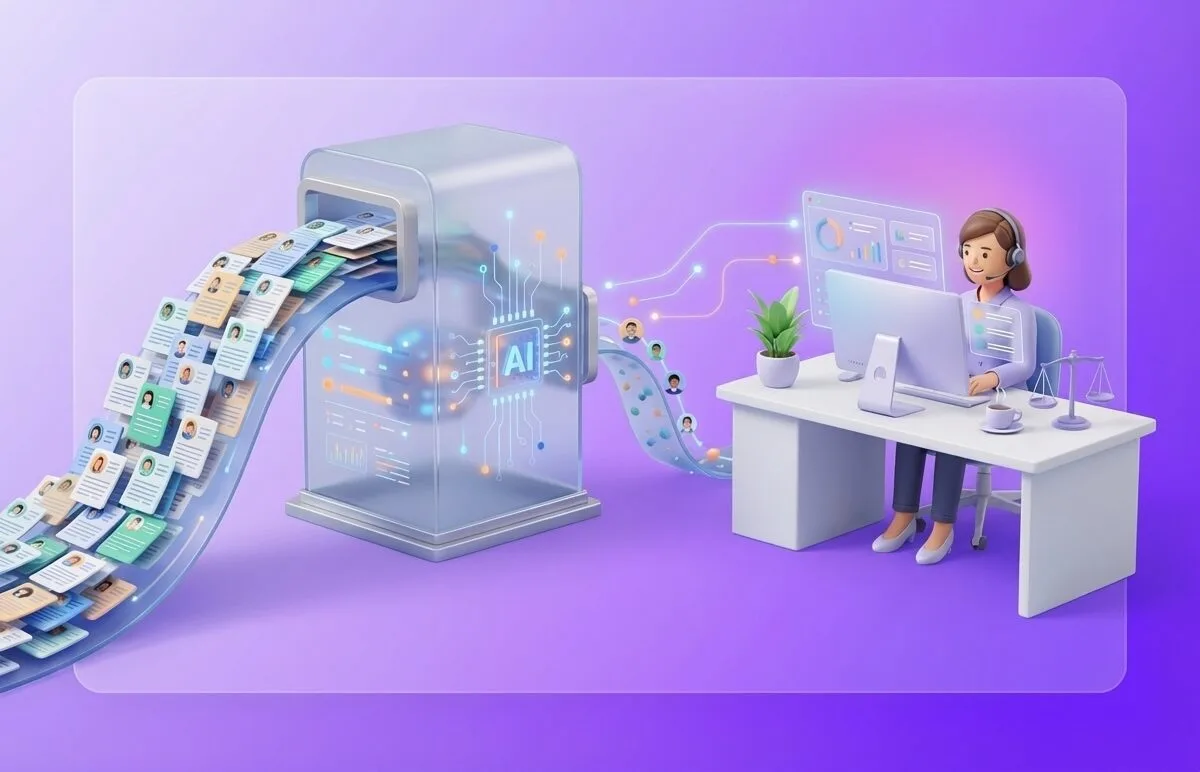
High-volume hiring breaks recruiters. Not because they lack skill – but because the process was never designed to scale. When you’re screening 100, 200, or 500 candidates for a wave of offshore, BPO, or frontline roles, manual phone screens and one-by-one CV reviews stop being a strategy and start being a liability. Top candidates accept other offers while your team is still working through page two of the applicant list. This guide covers how APAC hiring teams are solving high-volume hiring without burning out their people — and the specific tools and process changes that make the difference.
Why High-Volume Hiring Is Different (And Harder)
Most recruitment advice is written for low-volume, high-specialisation hiring — finding one senior engineer or one finance director. The rules are different when you need 50 customer support agents, 30 BPO operators, or a cohort of 100 management trainees at once.
At volume, the problems compound:
- Recruiter time runs out fast. Recruiters spend 6.5 to 9 hours on admin work per hire. Multiply that across 100+ candidates and you’ve consumed weeks of capacity before a single qualified person reaches a hiring manager.
- Speed determines who you hire. 42% of candidates accept offers from the agency or employer that responds fastest. In high-volume campaigns, your slowest screening step is actively costing you talent.
- Most screened candidates don’t qualify. Over 70% of screening interviews are conducted with ultimately unqualified candidates. That means the majority of your team’s time is spent eliminating people who should never have made it to a phone call in the first place.
- Consistency collapses at scale. When five recruiters are running back-to-back screens across different time zones, the evaluation criteria drifts. Who gets asked the hard follow-up question and who doesn’t becomes a function of which recruiter is tired, not what the role requires.
These aren’t edge cases. They’re the default experience for any team running offshore hiring campaigns or high-volume frontline recruitment in APAC.
What Breaks First When Hiring Volume Spikes
Before fixing the process, it’s worth naming exactly where the breakdown happens. Based on the experience of hiring teams across APAC, three bottlenecks appear consistently:
1. The Initial Screen Bottleneck
This is where volume does the most damage. A hiring team receives 400 applications. Someone has to decide which 80 are worth a phone call. That decision is typically made by skimming CVs for keywords — a process that rewards people who know how to format a resume, not people who can do the job.
The result: recruiters waste hours screening candidates who look qualified on paper but aren’t, while candidates who would perform well get filtered out because their CV doesn’t use the right terminology.
2. The Scheduling and Follow-Up Drain
Once you’ve identified candidates worth screening, coordinating interview times across different time zones, sending reminders, chasing no-shows, and following up with candidates who went quiet consumes enormous recruiter bandwidth. This is pure admin — it adds no assessment value, but it can’t be skipped.
3. The Inconsistent Evaluation Problem
In high-volume campaigns, interview guides get abbreviated. Recruiters start shortcutting follow-up questions after their eighth screen of the day. What starts as a structured process becomes informal, and informal processes produce inconsistent shortlists that hiring managers don’t trust.
How AI Screening Changes the Equation for High-Volume Hiring
The case for AI-assisted screening in high-volume hiring isn’t about replacing recruiters — it’s about removing the parts of the process that don’t require human judgment, so recruiters can spend their time where it actually matters.
Here’s what that looks like in practice with an AI voice interview platform like Talvin AI:
24/7 Screening With No Scheduling Required
AI voice interviews run around the clock. A candidate in Colombo can complete their screen at 10pm. A candidate in Kuala Lumpur can go at 7am before their current job starts. There’s no calendar coordination, no time zone math, no recruiter required to be online. The system handles hundreds of simultaneous interviews without degrading the experience for any individual candidate.
Janashakthi Group, a Sri Lankan conglomerate, used Talvin AI to screen 150 candidates in 5 days — a process that previously took 4 to 5 weeks when run manually. The volume didn’t change. The method did.
Consistent, Adaptive Questioning at Every Interview
Every candidate gets the same core questions in the same structured sequence. But unlike a pre-recorded video assessment where the question list is fixed regardless of what the candidate says, Talvin’s AI agent Sally asks contextual follow-up questions and deliberate curveballs based on the candidate’s actual responses.
This matters in high-volume hiring because it’s what separates candidates who have rehearsed a good answer from candidates who can actually reason through a problem. Recruiters can configure the drill-down depth per question — Low, Medium, or High — so the interview goes deep on the skills that matter most for the role and moves faster on lower-priority criteria.
Automatic Shortlisting Inside Your Existing ATS
The interviews run. The AI analyses the transcripts. A ranked, automatically shortlisted set of candidates appears inside your existing ATS — Ashby, Greenhouse, Workday, or Zapier — without anyone on your team having to manually review 400 recordings. Recruiters review the top tier. Hiring managers see only qualified candidates. The funnel does its job.
JXG processed 460+ applications through Talvin, completed 96 automated AI interviews, and produced a final shortlist of 10 candidates — the top 2% of the applicant pool — for their Spartan Summit final round. As Rehan Perera, Senior Assistant Manager of Human Resources at JXG, described it: “The platform ensured our process remained 100% transparent and data-driven.”
Practical Steps to Screen 100+ Candidates Without Burning Out Your Team
Implementing AI-assisted screening in a high-volume hiring campaign isn’t complicated, but it does require a shift in how the process is structured. Here’s what works:
Step 1: Define What You’re Screening For Before You Open Applications
The most common mistake in high-volume hiring is launching a campaign before the screening criteria are agreed. Recruiters end up screening based on gut feel because there’s no structured rubric. Before you post the role, identify the three to five criteria that will determine whether a candidate advances — communication quality, specific technical competency, relevant experience level, availability. Build your AI interview questions around those criteria specifically.
Step 2: Let AI Handle the First Screen Completely
Resist the temptation to have recruiters do a manual CV review before the AI screen. The CV review is the lowest-signal step in the process and the most time-intensive at volume. Let every qualified applicant complete an AI voice interview first. The AI will surface who’s worth a human conversation. You’ll catch more strong candidates and waste less time on weak ones.
The data supports this: over 70% of candidates who reach a screening interview are ultimately unqualified. AI screening applied before human time gets involved eliminates most of that wasted capacity.
Step 3: Configure Interview Depth to Match Role Complexity
A BPO customer service role doesn’t need the same interview depth as a technical finance position. Talvin lets you configure how aggressively Sally probes on each question. For frontline or volume roles, a lighter configuration with two to three targeted questions runs faster and still produces reliable differentiation. For roles requiring verified technical skills — where non-technical recruiters might struggle to assess competency — set the drill-down level to High and let the AI go deep on those specific areas.
Step 4: Use Job Tryouts for Customer-Facing and Performance-Critical Roles
For roles where on-the-job performance is hard to predict from an interview alone — customer support, hospitality, sales, contact centre — Job Tryouts place candidates inside realistic, role-specific scenarios powered by AI Persona Technology. Instead of asking a candidate how they’d handle a difficult customer, you put them in a simulated difficult customer interaction and observe what they actually do.
Companies using Job Tryouts report a 30 to 45% reduction in employee turnover. For high-volume hiring in BPO and customer-facing industries, where attrition is a persistent and expensive problem, that outcome is significant. The feature also produces a 62% reduction in time-to-hire and a 41% improvement in quality-of-hire in tracked deployments.
Step 5: Automate All Candidate Communication
Invites, reminders, follow-ups, and status updates should not require recruiter time in a high-volume campaign. Configure your ATS integration to trigger interview invitations automatically when a candidate applies. Set automated reminders for incomplete interviews. The recruiter’s job becomes reviewing the shortlist — not managing the logistics of getting candidates through the funnel.
What High-Volume Hiring in APAC Specifically Requires
High-volume hiring in APAC carries specific considerations that generic Western platforms don’t address well.
Linguistic diversity: Candidates across Singapore, Malaysia, Sri Lanka, India, Vietnam, and Indonesia speak English with a wide range of accents and proficiency levels. AI speech recognition that struggles with non-native English speakers doesn’t just produce bad transcripts — it actively disadvantages qualified candidates and produces unreliable shortlists. Talvin’s AI is engineered specifically for APAC linguistic diversity, with measured pacing and neutral, accessible delivery.
Time zone spread: Running a hiring campaign that spans multiple APAC markets means candidates are available at very different local times. 24/7 AI interviewing removes this constraint entirely — the process doesn’t wait for business hours in any single geography.
Compliance and data security: Enterprise clients like Sampath Bank PLC — a major Sri Lankan financial institution — required Talvin to meet rigorous security and compliance standards before approving an enterprise-wide rollout. The platform secured Board IT approval, demonstrating that AI-assisted screening can meet the requirements of regulated industries at scale. All candidate data is encrypted at rest and in transit, GDPR compliant, and PII is never used for model training.
Cost viability at volume: Many international AI screening platforms price per interview, which makes large-scale campaigns expensive quickly. Talvin’s per-minute pricing model means you pay for actual interview time used — an 8-minute technical screen and a 10-minute culture-fit interview cost 18 minutes of credit total. This makes the economics work for high-volume campaigns in the APAC SMB and mid-market. See current pricing plans here.
The Results When It Works
The outcomes from high-volume AI screening campaigns are measurable and consistent across different industries and markets:
- JXG: 460+ applications → 10 final shortlisted candidates, 96 AI interviews completed, top 2% of talent identified
- Code94 Labs: 488 resumes → 15 selected for final interviews in one week, 80% reduction in screening time
- Candidate satisfaction: average 4.3 out of 5 stars collected after every interview
High-volume hiring doesn’t have to mean recruiter burnout. It means a different process — one where the high-repetition, low-judgment tasks are handled by AI, and your team’s time is spent on decisions that actually require human insight.
Frequently Asked Questions
How do you screen 100+ candidates quickly without a large recruiting team?
The most effective approach is AI voice interview automation. Rather than scheduling individual phone screens, you deploy an AI agent that conducts structured, adaptive voice interviews with every applicant simultaneously — 24/7, without recruiter involvement. The AI analyses responses and returns a ranked shortlist directly into your ATS. Talvin AI can handle hundreds of concurrent interviews, allowing a small team to screen 100+ candidates in days rather than weeks.
What is the best AI screening tool for high-volume APAC hiring?
For APAC-specific hiring, the key requirements are localised voice AI that handles regional accents accurately, 24/7 availability across time zones, and per-minute pricing that stays economical at volume. Talvin AI is purpose-built for the APAC market — engineered for linguistic diversity across Singapore, Malaysia, India, Sri Lanka, Vietnam, and Indonesia — with ATS integrations for Ashby, Greenhouse, and Workday. See the full feature set at talvin.ai/products/ai-candidate-screening.
How does AI screening work for BPO and contact centre hiring?
BPO and contact centre roles require screening for communication quality, reasoning under pressure, and customer-handling ability at high volume. AI voice interviews assess all three in a structured, consistent format. For contact centre roles specifically, Job Tryouts can place candidates inside simulated customer interactions — testing how they actually respond to difficult scenarios, not just how they describe their approach. This is more predictive than a standard interview and scales without additional recruiter time.
Does AI candidate screening work for offshore hiring in Sri Lanka, India, or Malaysia?
Yes – provided the AI platform is built for APAC linguistic diversity. Talvin AI is engineered specifically for non-native English speakers across the region, with neutral pacing and accent-accessible delivery that reduces candidate anxiety and improves transcript accuracy. Talvin has active paying customers in Sri Lanka and has conducted successful pilots with enterprise clients in South Asia. More on offshore use cases at talvin.ai/offshore-hiring.
How do you reduce recruiter burnout in high-volume hiring campaigns?
Recruiter burnout in high-volume campaigns is primarily caused by three things: manual CV review at scale, scheduling coordination across large candidate pools, and repetitive phone screening. Removing all three from the recruiter’s workload — through automated AI interviews, ATS-triggered invitations and reminders, and AI-generated shortlists — leaves recruiters doing the work that requires human judgment: final interviews, offer conversations, and hiring manager alignment. Talvin automates the first stage entirely, including invites, reminders, and candidate follow-ups.
What is the difference between AI voice interviews and pre-recorded video interviews for high-volume hiring?
Pre-recorded video interviews ask candidates to record themselves answering fixed, static questions with no follow-up — the same questions regardless of what they say. AI voice interviews like Talvin’s are two-way and adaptive: the AI asks contextual follow-up questions and curveballs based on the candidate’s actual responses in real time. This produces higher-signal assessments because it tests reasoning and situational judgment, not just the ability to prepare a polished answer to a predictable question. Talvin also captures optional video of the candidate — so hiring teams get both the adaptive conversation depth and the visual data point.
Ready to Stop Burning Out Your Team on Manual Screens?
If your team is hiring 25 or more people per quarter, the manual screening process is costing you time, money, and candidates. Talvin AI runs structured, adaptive AI voice interviews 24/7 — and delivers a ranked shortlist directly into your ATS, in days instead of weeks.
Book a demo and see how Talvin handles high-volume hiring for APAC teams — without burning out the people running it.
Or explore more about AI for offshore hiring, Job Tryouts for frontline roles, and pricing for your hiring volume.