How to Prepare for an AI Voice Interview: A Candidate’s Complete Guide
What Is an AI Voice Interview?
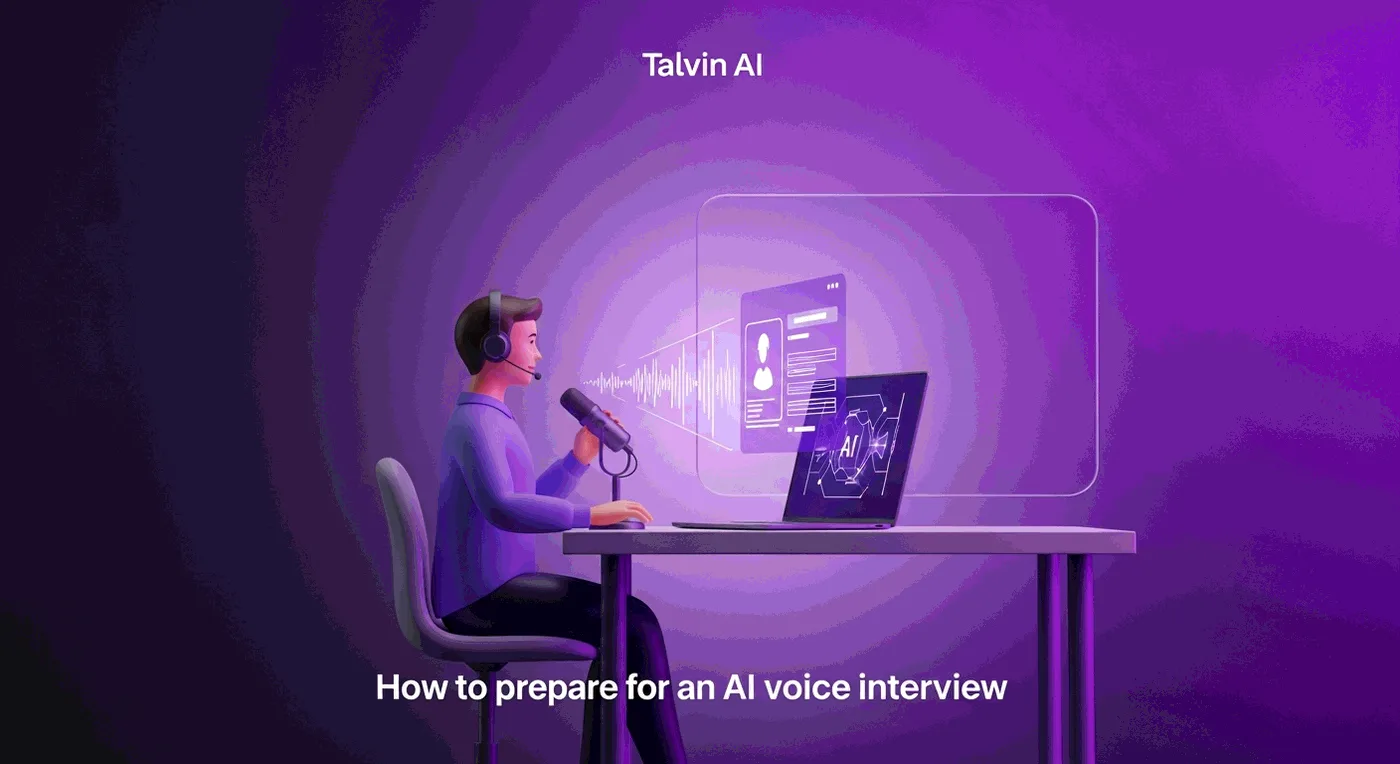
If you’ve applied for a job recently and received a link asking you to complete a voice interview on your own schedule, you’ve been invited to an AI voice interview. Instead of speaking with a human recruiter over the phone or video, you’ll have a real-time conversation with an AI interviewer that listens to your answers, asks follow-up questions, and evaluates your responses automatically.
This guide walks you through exactly what to expect, how to prepare, and how to give yourself the best chance of progressing to the next stage.
How an AI Voice Interview Works
An AI voice interview is a two-way, adaptive conversation. Here is the typical flow:
- You receive a link via email or WhatsApp. No scheduling required. You complete the interview at a time that works for you, 24 hours a day.
- The AI interviewer asks an opening question. This is usually related to your background, the role, or a specific skill mentioned in the job description.
- The AI listens to your answer and responds in real time. Unlike video interview platforms where you record yourself answering pre-set questions, AI voice interviews are dynamic. The interviewer asks follow-up questions based on what you actually say, probing deeper on interesting points or asking for clarification if your answer is vague.
- The interview typically lasts 15 to 25 minutes. You will be asked a series of questions covering your experience, role-specific competencies, and situational judgment.
- Your responses are analysed and a structured scorecard is generated. Recruiters review this shortlist and decide who to invite for the next stage.
The key difference from a traditional phone screen is that you are not speaking with a human. There is no small talk, no mutual pleasantries, and no reading of the interviewer’s body language. But there are also no unconscious biases based on your name, accent, or appearance. Your answers are evaluated on their content.
How to Prepare for an AI Voice Interview: 7 Practical Steps
1. Find a Quiet Environment
Background noise is the most common reason candidates perform below their best in AI voice interviews. The AI is transcribing your speech in real time. Road noise, music, or a loud household will reduce transcription accuracy and make your answers harder to evaluate fairly.
Choose a room where you can close the door. If you are on mobile, avoid windy outdoor environments. A pair of earphones with a built-in microphone (like standard phone earbuds) will significantly improve audio quality compared to using your phone’s built-in speaker.
2. Use a Reliable Device
You can complete an AI voice interview from any smartphone, laptop, or tablet with a working microphone. Unlike video interviews, you do not need a camera or a presentable background. You just need a stable voice connection.
Check your internet connection before starting. A dropped connection mid-interview can interrupt the flow and create unnecessary stress. If your home Wi-Fi is unreliable, use mobile data or find a stable connection point first.
3. Read the Job Description Carefully and Speak to It
AI interviewers are configured by the hiring company to ask questions about the specific competencies they care about most for that role. If the job description mentions client communication, data analysis, or team leadership, expect those topics to come up.
Prepare two to three examples from your past work for each key requirement listed in the job description. Use the STAR framework: Situation, Task, Action, Result. Specific, concrete examples score higher than general statements about your capabilities.
4. Expect Follow-Up Questions and Do Not Memorise Scripts
One of the most important things to know about preparing for an AI voice interview is that the interviewer adapts to your answers. If you give a vague or overly brief response, the AI is likely to probe deeper: “Can you walk me through a specific example?” or “What was the outcome of that decision?”
Memorising rehearsed scripts tends to backfire because your canned answer will not match the follow-up question. Instead, focus on deeply understanding your own experience and being able to speak about it naturally. The goal is a genuine conversation, not a performance.
Some AI interviewers are also configured to ask deliberate curveball questions. These are hypothetical scenarios, ethical dilemmas, or edge cases specifically designed to test your situational judgment. There is no trick to these: think out loud, share your reasoning process, and be honest about how you would approach an unfamiliar situation.
5. Speak Clearly and at a Natural Pace
You do not need to speak in a particular accent or formal register. AI voice interviewers built for the APAC market are specifically engineered to understand a wide range of accents and natural speech patterns. Platforms like Talvin AI’s Sally are built with APAC linguistic diversity in mind.
What matters more than accent is clarity and pace. Speak at a conversational speed. Not rushed, not unnaturally slow. If you are nervous, taking a breath before answering is completely fine. Pausing to think is not penalised.
6. Do Not Try to Game the Interview
Some candidates look for ways to beat AI screening systems by including keyword-heavy phrases or using AI tools to generate answers in real time. This generally does not work and often produces the opposite effect.
Modern AI interviewers are adaptive. They verify claims by going deeper. If you claim to have led a team of 15 engineers, expect a follow-up about how you handled a specific team conflict or technical decision. Generic, keyword-stuffed answers that lack specificity tend to score poorly on competency dimensions.
The most effective approach is also the most honest one: speak from real experience, give concrete examples, and engage with the questions genuinely.
7. Do a Quick Dry Run
If you have never done an AI voice interview before, the format can feel unfamiliar. Most platforms will send you a test link or allow you to record a practice answer before the real interview starts.
Use it. Hearing your own voice played back in the interface, and understanding how the question-and-answer flow works, will make the actual interview feel less jarring. Treat the practice question exactly as you would a real one.
What Happens to Your Answers
After your interview is complete, the AI generates a structured evaluation for the hiring team. This typically includes:
- A transcript of the full conversation
- Scores or ratings per competency area such as communication, technical depth, and problem-solving
- A summary of key highlights from your answers
- A shortlist ranking relative to other candidates who completed the same interview
A recruiter reviews this output before making shortlisting decisions. The AI does not make the hiring decision. It organises the information so recruiters can make a better-informed one.
On platforms like Talvin AI, candidates also receive a post-interview satisfaction rating collection. Candidate experience is treated as a first-class metric. The average candidate satisfaction rating on Talvin interviews is 4.3 out of 5.
Common Mistakes Candidates Make
- Starting without testing audio first. The AI cannot hear you clearly if your microphone is not working. Test it before clicking Start Interview.
- Giving one-sentence answers. Brief answers invite follow-up questions. Aim for 60 to 90 seconds per response. Enough to demonstrate depth without rambling.
- Treating it as less serious than a human interview. Recruiters review AI interview scores alongside every other stage. Candidates who perform poorly because they did not take it seriously are consistently filtered out.
- Not asking clarifying questions when confused. If you do not understand a question, say so. The AI interviewer is designed to rephrase or clarify. Attempting to answer a question you did not understand produces a worse outcome than asking for clarification.
- Quitting mid-interview. Incomplete interviews are difficult for recruiters to evaluate and typically result in the candidate not being shortlisted. If something genuinely goes wrong, contact the hiring team directly to request a reset link.
A Note on Video During AI Interviews
Some AI interview platforms, including Talvin AI, offer optional video capture alongside the voice interview. Whether video is enabled depends on the hiring company’s configuration. It is not a universal feature and not all interviews will record your camera.
If video is enabled, the hiring team has chosen to see you on camera as an additional data point. The same way a traditional interview would. Treat it as you would any professional video call: presentable environment, appropriate clothing, and look into the camera when speaking.
You do not need to perform differently based on whether video is on or off. The core evaluation is driven by the quality of your voice responses.
After the Interview: What to Expect
Timeline varies by company. Some organisations shortlist within 24 to 48 hours. Others batch-review at the end of a recruiting cycle. If you have not heard back within the timeframe communicated in the invitation, it is appropriate to follow up with the hiring team via email.
Most AI interview platforms are designed to give every candidate a fair, complete evaluation. You will not be cut off at an arbitrary time limit or scored on factors outside your control. The evaluation is based on what you say, how you say it, and whether your experience matches the role requirements.
What Employers Are Looking for in an AI Voice Interview
While every role is different, hiring teams using AI voice interviews are generally evaluating several core dimensions:
- Relevant experience and specificity. Can you demonstrate you have done this kind of work before, with specific examples?
- Communication clarity. Are your answers coherent, structured, and easy to follow?
- Situational judgment. When given a scenario, do you show sound reasoning?
- Role and cultural fit signals. Do your motivations and working style align with what the company is hiring for?
Companies using platforms like Talvin AI configure additional competency layers specific to the role. Technical depth, customer service orientation, leadership capacity. Your preparation should be grounded in the specific job you are applying for, not a generic interview script.
AI Voice Interview Preparation: Quick-Reference Checklist
- [ ] Find a quiet room with minimal background noise
- [ ] Test your microphone and internet connection before starting
- [ ] Read the job description and prepare STAR examples for each key requirement
- [ ] Use earphones with a microphone for better audio quality
- [ ] Complete the practice question if one is offered
- [ ] Plan to answer each question with 60 to 90 seconds of detail
- [ ] Speak naturally and do not read from a script
- [ ] Stay for the full interview. Incomplete interviews are rarely shortlisted.
Frequently Asked Questions About AI Voice Interviews
How long does an AI voice interview take?
Most AI voice interviews are 15 to 25 minutes long, depending on the role and how many questions the hiring company has configured. You can usually see an estimated time in the invitation email before you start.
Can the AI tell if I am using ChatGPT or reading from a script?
AI interviewers are configured to follow up with specific probing questions based on your answers. If you are reading a pre-written AI-generated response, the follow-up questions will quickly expose gaps in your knowledge. The best strategy is to speak from real experience.
What if I do not understand a question during the AI interview?
Say so. Most AI interviewers are designed to handle clarification requests. Saying “I am not sure I understood that question, could you rephrase it?” is a better outcome than attempting to answer a question you did not grasp.
Does my accent affect how I am evaluated in an AI voice interview?
It depends on the platform. AI interview tools built specifically for APAC markets, like Talvin AI, are engineered to understand a wide range of accents across Singapore, Malaysia, India, Sri Lanka, Vietnam, Indonesia, and the Philippines. If you are interviewing with a platform built primarily for the US or UK market, speech-to-text accuracy may be lower for non-native English speakers.
How is an AI voice interview different from a video interview?
A traditional video interview, like those conducted on HireVue or similar platforms, typically asks you to record yourself answering pre-set questions on camera. You are speaking to a camera, not having a conversation. An AI voice interview is a two-way real-time dialogue: the AI listens to you, adapts its questions based on your answers, and probes deeper when relevant. It is closer in format to a phone screen than a recorded video submission.
Can I pause the AI interview and come back to it later?
Most platforms do not allow mid-interview pauses. Once you start, the session runs to completion. Check the platform instructions before beginning. If you need to stop for a genuine reason such as a technical issue or emergency, contact the hiring team to request a fresh session link rather than abandoning the interview mid-way.
What happens if I give a wrong answer?
AI voice interviews evaluate a range of competencies across multiple questions. A single weak answer will not automatically disqualify you. Recruiters review the full scorecard, not just individual question scores. Stay focused on each question as it comes rather than dwelling on a previous response.
For Employers: Running AI Voice Interviews at Scale
If you are a recruiter or hiring manager building a high-volume screening process, Talvin AI’s Sally handles first-stage interviews automatically, screening candidates 24/7 with adaptive voice AI and returning a structured shortlist directly to your ATS.
Janashakthi Group screened 150 candidates in 5 days using Talvin, a process that previously took 4 to 5 weeks manually. JXG processed 460 applications and identified a final shortlist of 10 top candidates for their management trainee programme, described by their HR team as 100% transparent and data-driven.
Book a demo to see how Talvin works for high-volume hiring in APAC, or learn more about AI candidate screening for your team.