Agentic Hiring: What It Is and Why Voice AI Is the Foundation
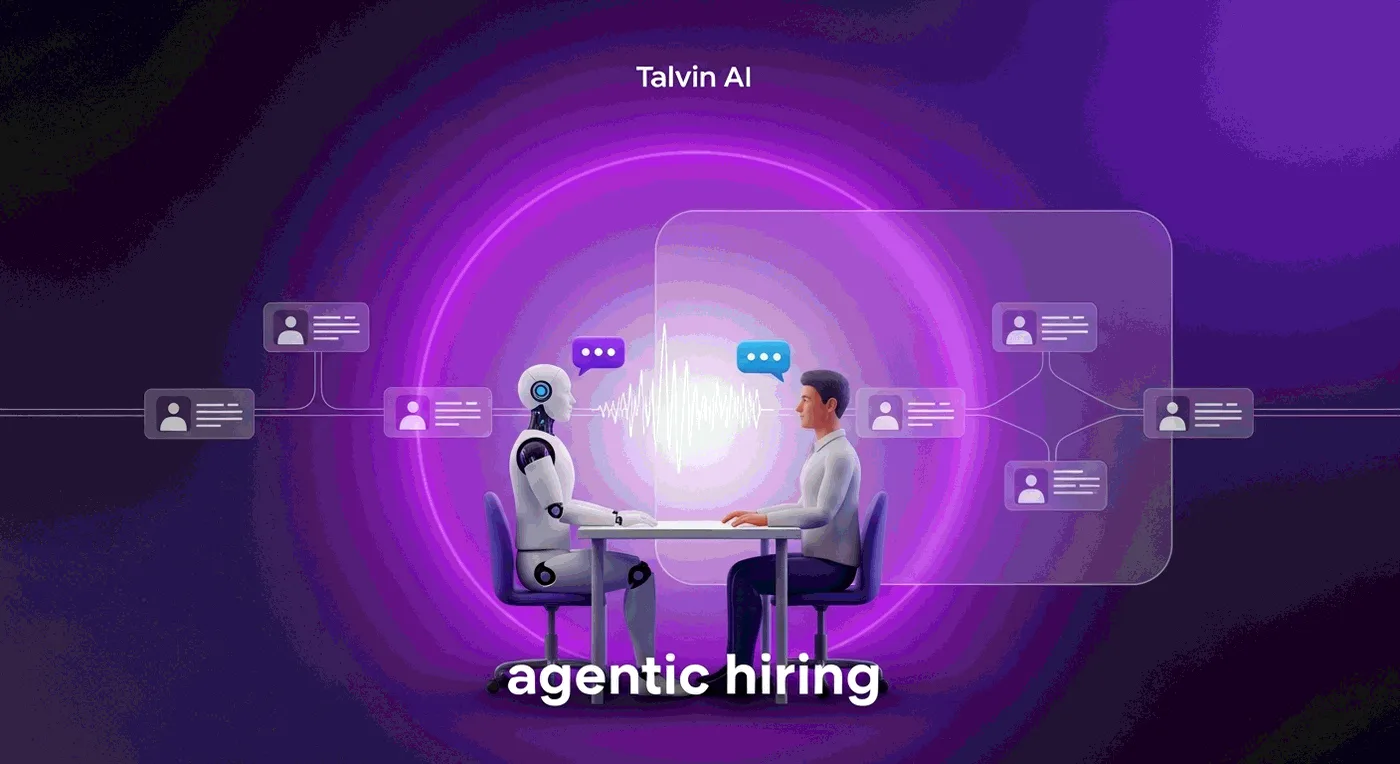
Agentic hiring is the use of autonomous AI agents that conduct, adapt, and evaluate candidate screening in real time — without a human recruiter in the loop for every interaction. It is not a chatbot asking fixed questions. It is not a pre-recorded video platform waiting for candidates to answer a camera. Agentic hiring means the AI listens, thinks, follows up, probes deeper, and adjusts — the same way a skilled recruiter would. And the reason voice AI sits at the foundation of this shift is straightforward: conversation is the highest-signal screening format available, and voice is how real conversations happen.
If you are running high-volume hiring across APAC — or managing a recruitment function where your team is buried in applications and still losing top candidates to faster-moving competitors — this distinction matters. The tools your team adopts in the next 12 months will determine whether AI genuinely accelerates your hiring or simply automates the wrong thing faster.
What “Agentic” Actually Means in a Hiring Context
The word agentic comes from AI research. An agentic AI system does not wait for instructions at every step. It pursues a goal autonomously, making decisions along the way based on what it observes.
In recruitment, the difference between agentic AI and conventional AI tooling looks like this:
- Conventional AI screening: A candidate receives five pre-set questions. They answer each one in turn. The AI scores their responses against a rubric. The recruiter reviews the scores.
- Agentic AI screening: The AI starts with a question, listens to the answer, identifies a gap or an interesting signal, and decides in real time what to ask next. If a candidate claims three years of experience managing enterprise SaaS accounts, the agent probes that claim with a specific situational question. If the answer is thin, it goes deeper. If it is strong, it moves on.
The output is fundamentally different. Conventional AI measures how well a candidate answers a fixed question. Agentic AI measures how a candidate actually thinks, responds under pressure, and handles the unexpected — which is a far better predictor of job performance.
This is why over 70% of screening interviews are conducted with ultimately unqualified candidates under traditional methods. Keyword matching on a CV, or even a fixed-question video interview, does not surface genuine competency. It surfaces candidates who are good at optimising for that specific format.
Why Voice AI Is the Right Foundation for Agentic Hiring
There are three modalities available for AI-driven screening: text chat, pre-recorded video, and voice. Each has a distinct profile.
Text chat is low-friction but low-signal. Candidates type answers at their own pace. There is no sense of how someone communicates under real conditions — no hesitation, no ability to gauge reasoning speed or verbal fluency. Easily gamed by copy-pasting prepared answers.
Pre-recorded video gives you a visual of the candidate, but the interaction is one-directional. The AI asks a fixed question. The candidate records themselves answering it. There is no follow-up, no curveball, no adaptive depth. What you learn is how well someone performs to a camera with unlimited preparation time.
Voice AI is the only modality that replicates the dynamics of an actual interview. The candidate speaks. The AI listens in real time. The AI responds based on what was said — not based on a script. This creates conditions that are genuinely difficult to game, and that surface how a candidate thinks, communicates, and handles the unexpected.
For agentic hiring to work — for the AI to pursue the goal of genuine competency assessment rather than just question delivery — it needs a modality that allows real-time adaptation. Voice is that modality.
Critically, this does not mean abandoning the visual dimension. Talvin’s AI candidate screening platform combines two-way adaptive voice AI with optional video capture of the candidate. The hiring organisation decides whether to enable video recording. Most do, because it adds meaningful data: how the candidate presents themselves, visual legitimacy verification, and cultural fit signals. The result is more information than any pure video platform provides — you hear how the candidate thinks in real time, and you see how they present themselves.
What Agentic Hiring Looks Like in Practice
Talvin’s AI agent is named Sally. Here is what an agentic voice AI interview looks like in practice:
- The recruiter configures the assessment. They set the role, the competencies they care about, and — critically — the drill-down depth per question. Low, Medium, or High probing level. A question about communication skills might be set to Low. A question about technical architecture decisions might be set to High.
- The candidate receives an invitation and joins the interview 24/7 — no scheduling required, no recruiter present.
- Sally conducts the interview. She opens with structured questions, listens to responses, and adapts in real time. If a candidate gives a vague answer, she probes. If they reference a specific technology or situation, she follows the thread. She throws deliberate curveballs to test situational judgment — not to trick candidates, but to see how they respond to the unexpected.
- The AI analyses the transcript. It produces a structured shortlist with scoring, ranked candidates, and the evidence behind each assessment. The recruiter reviews outputs — not raw recordings — and makes faster, better-informed decisions.
This is what allowed Janashakthi Group, a conglomerate based in Sri Lanka, to screen 150 candidates in 5 days — a process that previously took 4 to 5 weeks manually. The recruiter team’s time was not eliminated. It was redirected from screening volume to evaluating a curated shortlist.
The Specific Problem Agentic Hiring Solves for APAC Teams
High-volume hiring in APAC has a structural problem that generic AI tools do not address well. The candidate pool is large. The linguistic diversity is significant. The pace of competition for top talent is fast — best candidates are hired within days, not weeks. And most AI screening tools built in the US or Europe are calibrated for Western English accents and interview conventions.
A voice AI agent that creates friction for non-native English speakers — through accent mismatch, unnatural pacing, or speech recognition failures — is not a useful tool for Singapore, Malaysia, Sri Lanka, India, Vietnam, or Indonesia. It is a barrier.
Talvin is engineered specifically for APAC linguistic diversity. Sally speaks at a measured pace with a neutral, easy-to-understand accent. The speech recognition is built to handle the full range of accents present in the APAC talent market — not just candidates who approximate a Western English speaker. This is not a minor detail. It is the difference between a tool your candidates complete and one they abandon.
The results are measurable. Talvin collects candidate satisfaction scores after every interview. The average rating is 4.3 out of 5. For a recruitment tool conducting AI-driven screening at scale, that number reflects a candidate experience that does not create drop-off or reputational damage for the hiring brand.
Agentic Hiring Goes Beyond Screening: Job Tryouts
The logical extension of agentic hiring is moving beyond conversation into demonstrated performance. Voice AI interviews reveal how candidates think and communicate. But the fundamental limitation of any interview — AI or human — is that it measures how someone interviews, not how they perform in the actual role.
Talvin’s Job Tryouts address this directly. Instead of asking a customer service candidate how they would handle a difficult customer, Job Tryouts place the candidate inside that scenario. Powered by AI Persona Technology, a dynamic virtual character plays the difficult customer. The candidate has to navigate the interaction in real time.
The AI evaluates decision-making, communication, creativity, and role fit based on what the candidate actually does — not what they say they would do. This distinction produces fundamentally more predictive hiring decisions. Companies using Job Tryouts report a 30–45% reduction in employee turnover. This feature was specifically recognised when Talvin won the VAPI Global Voice AI Hackathon, placing in the top 10 globally.
Job simulations represent the furthest point of the agentic hiring spectrum: an AI agent that does not just screen candidates but genuinely tests them against the demands of the role before a single offer is made.
What Agentic Hiring Is Not
Because “agentic AI” is becoming a marketing term, it is worth being precise about what it does not mean:
- It is not a scripted chatbot. Linear chatbots follow decision trees. They cannot probe an unexpected answer, adapt to what a candidate says, or go deeper on a specific competency. They are easily gamed by anyone who has seen the question set once.
- It is not a one-way video platform. Pre-recorded video assessments have no adaptive capacity. The AI cannot follow up. The candidate answers to a camera, not to an agent.
- It is not a human replacement. Agentic hiring removes the recruiter from the screening volume problem — they do not need to be present for every initial interview. But it delivers better-qualified shortlists for human decision-makers to act on. The recruiter’s judgment is applied where it creates the most value: evaluating the best candidates, not sorting through hundreds of applications.
How to Evaluate Whether a Tool Is Genuinely Agentic
If you are assessing voice AI or AI screening platforms for your organisation, ask these questions:
- Does the AI ask follow-up questions based on what the candidate actually said — or does it follow a fixed script regardless of the answer?
- Can you configure how deeply the AI probes on specific competencies?
- Does the tool produce structured, auditable scoring — or a black-box output you cannot explain to a candidate or a hiring manager?
- Can the tool operate simultaneously across hundreds of candidates, 24/7, without recruiter intervention?
- Is the AI calibrated for your candidate population’s language and accent profile?
These questions separate tools that use “agentic” as a label from tools that deliver agentic capability in practice. For teams running high-volume hiring across APAC, the answers determine whether AI accelerates your recruitment or simply adds a new layer of complexity to manage.
JXG processed 460 applications through Talvin’s platform and completed 96 automated AI interviews, identifying the top 2% of talent and producing a final shortlist of 10 candidates for their management trainee final round. Their HR team described the process as “100% transparent and data-driven.” That outcome — from application volume to elite shortlist — is what agentic hiring is designed to produce.
See how Talvin’s AI candidate screening works →
Getting Started with Agentic Hiring
Agentic hiring does not require replacing your existing recruitment infrastructure. Talvin integrates directly with the ATS platforms most APAC and global teams already use: Ashby, Greenhouse, Workday, and Zapier are all live. The platform sits on top of your existing workflow — automatically pulling candidates from your ATS, triggering interviews, sending invites and reminders, and returning a ranked shortlist within your existing tools.
Pricing starts at $175 per month on the Startup tier, with a per-minute consumption model that keeps costs viable even at scale. Enterprise plans include unlimited interviews, white-label branding, and custom ATS integration. See full pricing →
If your team is hiring 25 or more people per quarter, the ROI case for agentic voice AI is straightforward. The question is not whether to automate screening — it is whether the tool you choose is genuinely agentic or just a more expensive version of the fixed-question formats you already have.
Frequently Asked Questions
What is agentic hiring?
Agentic hiring is an approach to recruitment where autonomous AI agents conduct candidate screening in real time — listening to responses, deciding what to ask next, probing specific competencies, and adapting the conversation based on what the candidate says. Unlike fixed-question video or chat tools, agentic AI behaves more like a skilled interviewer than a form.
How is voice AI different from a video interview platform for hiring?
Video interview platforms typically record candidates answering pre-set static questions — the AI cannot follow up or adapt. Voice AI conducts a real-time two-way conversation where the AI listens and responds dynamically based on what the candidate says. Voice AI produces higher-signal assessments because it replicates the conditions of a real interview and is much harder for candidates to game with prepared answers.
Can voice AI hiring tools handle non-native English speakers accurately?
It depends on the platform. Some tools are built and calibrated primarily for Western English speakers, which creates friction and accuracy issues for APAC candidates. Talvin’s voice AI agent is engineered specifically for APAC linguistic diversity — calibrated for the range of accents and speech patterns across Singapore, Malaysia, India, Sri Lanka, Vietnam, and Indonesia.
What is the difference between agentic AI and a scripted chatbot for recruitment?
A scripted chatbot follows a fixed decision tree — it asks the same questions in the same order regardless of what the candidate says. An agentic AI agent makes real-time decisions about what to ask next based on the candidate’s actual responses. It can probe unexpected answers, go deeper on a specific competency, and throw deliberate follow-up questions that test situational judgment. Scripted chatbots are easily gamed once candidates know the question set.
How many candidates can a voice AI system interview at once?
Talvin’s platform handles hundreds of simultaneous interviews and operates 24/7 — there is no scheduling bottleneck and no capacity limit tied to recruiter availability. This is what enables outcomes like screening 150 candidates in 5 days (Janashakthi Group) or processing 460 applications and completing 96 automated AI interviews in a single hiring cycle (JXG).
Does agentic hiring replace human recruiters?
No. Agentic hiring removes recruiters from the volume problem — they are not present for every initial screening interview. But it produces better-qualified shortlists for human decision-makers to evaluate. Recruiter judgment is applied where it creates the most value: assessing top candidates, building relationships, and making final hiring decisions.
What ATS platforms does Talvin integrate with?
Talvin is live with Ashby, Greenhouse, Workday, and Zapier. Teamtailor integration is in development for the European market. Enterprise plans include custom ATS integration options.
See Agentic Hiring in Action
Talvin’s voice AI platform is purpose-built for high-volume APAC hiring. If your team is processing more applications than your recruiters can handle — or losing top candidates to competitors who move faster — agentic hiring is worth a direct look.
Book a demo → and see how Sally handles a real screening conversation for your roles.
Already know what you need? Review pricing and start a trial →