Voice AI Recruiting: The Complete 2026 Guide to Agentic Hiring AI
Introduction
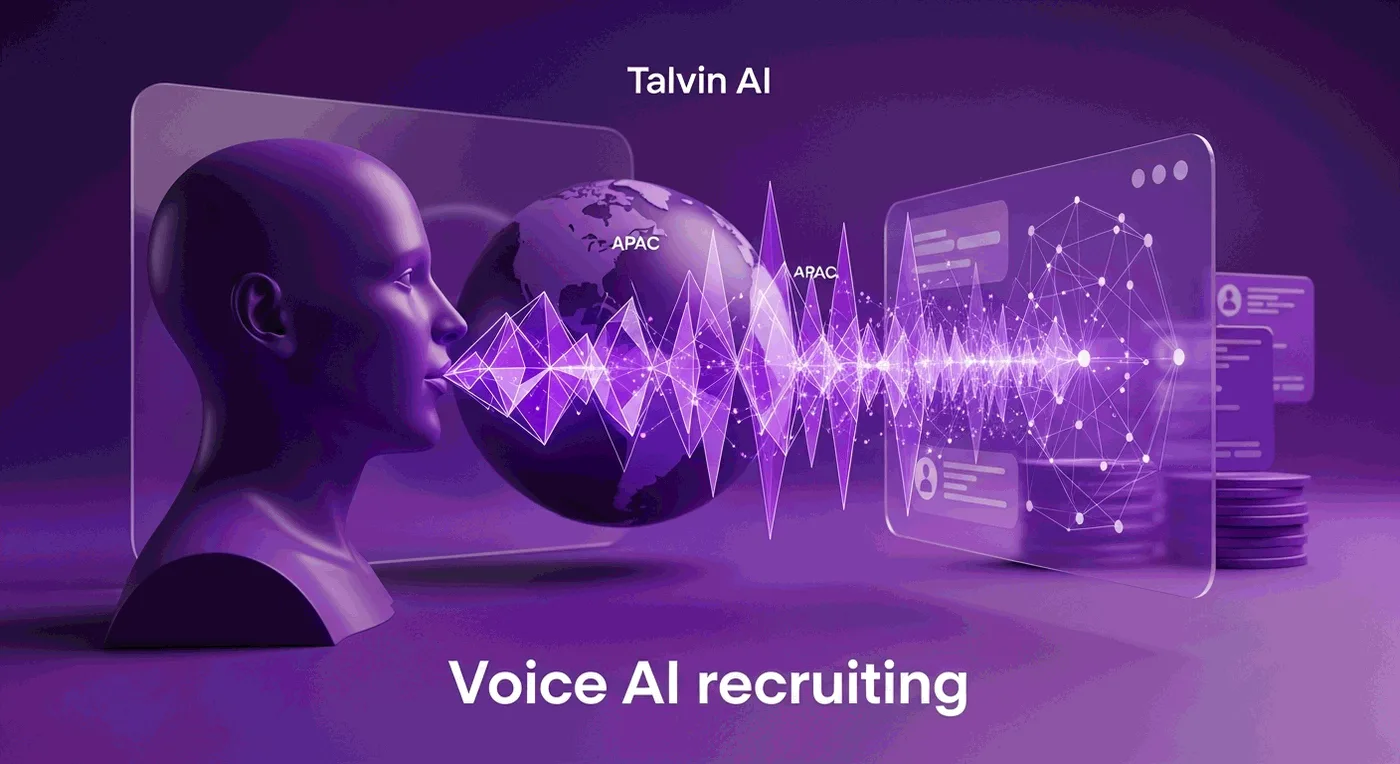
Voice AI recruiting is the use of real-time, two-way conversational AI to conduct candidate interviews over voice — asking adaptive follow-up questions based on what a candidate actually says, rather than relying on a static list of questions or a resume keyword match. It’s different from video AI screening (which is typically one-way and pre-recorded) and different from chatbot screening (which is scripted and text-based, and easily gamed).
In 2026, voice AI has moved from a niche feature to something closer to an expected capability. HireVue, historically a video-only platform, acquired Hireguide in March 2026 specifically to add voice AI to its product. That shift alone tells you where the category is heading. But adding voice to a product isn’t the same as building an agentic recruiting system — one that probes, adapts, and reasons through a conversation the way a skilled human interviewer would.
This guide breaks down what voice AI recruiting actually is, how agentic AI changes the equation, how it compares to video and chat-based screening, and what to look for if you’re evaluating a platform for high-volume hiring in 2026.
What Is Voice AI Recruiting?
Voice AI recruiting replaces the first-round phone or video screen with an AI-led voice conversation. The candidate talks; the AI listens, responds, and asks follow-up questions in real time — the same way a human recruiter would run a screening call, minus the scheduling friction and the recruiter’s limited working hours.
Talvin AI’s voice agent, Sally, is text/voice based — there’s no avatar, no uncanny digital face. The interaction is fully adaptive and two-way. Sally asks contextual follow-up questions and deliberate “curveballs” to verify technical skills and situational judgment, not just whether a candidate can recite a rehearsed answer.
This matters because over 70% of screening interviews are conducted with candidates who turn out to be unqualified — a direct result of resumes being static, self-reported documents that reward keyword-stuffing over genuine competency. Voice AI, done well, closes that gap by testing how someone actually thinks, in real time.
Agentic AI Recruiting: The Category Voice AI Is Becoming
“Agentic AI” is the term recruiting platforms are increasingly using to describe systems that don’t just ask questions — they reason, adapt, and make decisions mid-conversation. This is the real dividing line in 2026, more than voice versus video.
A non-agentic voice tool asks Question 1, waits for an answer, asks Question 2. An agentic voice tool listens to the answer to Question 1, decides whether it was vague or evasive, and digs deeper before moving on — the way a strong interviewer naturally would.
Talvin’s agentic depth shows up in a specific, configurable way: recruiters can set a drill-down depth per question — Low, Medium, or High — so Sally goes deep on the skills that actually matter for a role and moves lightly through the rest. This is also what allows non-technical recruiters to vet technical talent with confidence — the AI does the probing that would otherwise require a subject-matter expert on every call.
Why This Matters More Than “Voice vs. Video”
The old debate was video versus voice. The more useful debate in 2026 is static versus adaptive. A pre-recorded video interview — even a well-produced one — is still a one-way monologue into a camera. A scripted chatbot is still a fixed decision tree. Only an agentic system can respond to a candidate’s actual words in the moment, which is the entire point of an interview in the first place.
Voice AI vs. Video AI vs. Chat Screening: Side-by-Side
| Dimension | Voice AI (Agentic) | Video AI (One-Way) | Chat / Text Screening |
|---|---|---|---|
| Interaction style | Two-way, real-time conversation | One-way, pre-recorded response to static questions | Scripted, linear decision tree |
| Adapts to candidate answers | Yes — contextual follow-ups and curveballs | No — fixed question set | No — easily gamed with rehearsed keywords |
| Verifies technical/situational judgment | Yes, via probing depth (Low/Medium/High) | Limited — depends on candidate’s self-presentation | Minimal |
| Candidate visual data point | Optional video capture available alongside voice | Video is the entire format | None |
| Recruiter time required | Runs 24/7, hundreds of interviews simultaneously | Recruiter still reviews recordings manually | Low, but low-signal |
| Best suited for | High-volume technical and non-technical screening at scale | Roles where visual presentation is the primary signal | Very early top-of-funnel filtering only |
It’s worth being precise here: Talvin is not a voice-only platform. It’s a two-way adaptive voice AI system with optional video capture — the hiring organisation, not the candidate, decides whether to enable it. Most organisations turn it on, because it adds a real data point: visual presentation, cultural fit signals, and confirmation the candidate is who they say they are. The combination — hearing how someone thinks in real time and seeing how they present — gives recruiters more signal than a pure video platform or a pure voice-only tool ever could.
How Voice AI Recruiting Works in Practice
- Candidates apply as normal through your existing careers page or job board — no new candidate-facing system to build.
- The AI interview is triggered automatically via ATS integration (Talvin currently integrates live with Ashby, Greenhouse, Workday, and Zapier, with Teamtailor in development for the European market).
- The candidate completes a real-time voice conversation with Sally, on their own schedule, in a language and accent-neutral format built for regional diversity.
- Sally probes deeper on configured questions, throwing follow-ups and curveballs where the recruiter has set higher drill-down depth.
- A structured, shortlisted set of candidates is delivered back into the client’s existing ATS — no new dashboard to learn, no manual re-entry.
What Voice AI Recruiting Solves
The Volume Barrier
High-growth companies drown in application volume long before they run out of qualified candidates. Top talent gets hired within days by whoever moves fastest — and manual screening simply can’t keep pace. Talvin runs hundreds of concurrent interviews, 24/7, which is the only way to keep up when application volume outpaces recruiter capacity.
The Insight Barrier
Resumes are self-reported and static. Voice AI, when it’s agentic, replaces keyword matching with a genuine, adaptive conversation — which is precisely how Talvin eliminates a meaningful share of the 70% of screening interviews wasted on unqualified candidates.
Proof in the Numbers
At Janashakthi Group, a Sri Lankan conglomerate, Talvin screened 150 candidates in 5 days — a process that previously took 4 to 5 weeks manually. Candidate satisfaction across Talvin interviews averages 4.3 out of 5 stars, collected after every interview, which addresses a common assumption that AI screening damages candidate experience.
At Code94 Labs, hiring manager Beenali Dangalle described the shift directly: “488 Resumes → 15 selected for final interviews in just a week. We cut screening time by 80% and still hired better people. Talvin’s voice assessments felt like having 10 recruiters working around the clock.”
And at JXG, running a 2026 Management Trainee Program, Senior Assistant Manager – HR Rehan Perera processed 460+ applications and completed 96 automated AI interviews, narrowing the field to the top 2% of talent for a final shortlist of 10 candidates. In his words: “the platform ensured our process remained 100% transparent and data-driven.”
Talvin has also secured Board IT approval from Sampath Bank PLC for enterprise-wide rollout following a successful pilot — a meaningful signal given the security and compliance bar in financial services — and is moving toward full implementation with global EdTech company Mindvalley.
The 2026 Competitive Landscape
Voice AI in recruiting is no longer a differentiator on its own — it’s becoming table stakes. HireVue’s move to acquire voice AI capability in March 2026 is the clearest signal of that shift. What still separates platforms is depth: how adaptive the conversation actually is, whether the platform measures real job performance rather than interview performance, and whether it’s built for the market it’s selling into.
Compared with HireVue, which historically relied on pre-recorded, one-way video with static question sets, Talvin’s Sally adapts dynamically based on what a candidate actually says — and Talvin includes Job Tryouts, realistic role simulations that HireVue does not offer.
Compared with Interviewer.AI, whose core product remains asynchronous one-way video with static, pre-set questions, Talvin combines adaptive voice conversation with optional video capture — giving recruiters more data, not less. Interviewer.AI’s speech recognition and scoring has also been documented (in customer reviews) to struggle with non-native English speakers, which is a meaningful gap for an APAC-facing product.
Compared with Vervoe, which focuses on text-based skills tests, Talvin adds the conversational depth and voice signal that a written assessment simply cannot capture.
Talvin’s own edge in this landscape isn’t voice alone — it’s the combination of agentic depth, Job Tryouts (winner of the VAPI Global Voice AI Hackathon), and an interview experience engineered specifically for APAC accents and pacing, at a per-minute price point built for high-volume hiring rather than enterprise-only budgets.
What to Look For When Evaluating a Voice AI Recruiting Platform
- Is it actually adaptive, or just voice-shaped? Ask whether the AI can ask a genuine follow-up question based on an answer it hasn’t seen before, or whether it’s reading from a fixed script.
- Can non-technical recruiters use it for technical roles? If the platform requires a subject-matter expert to write and interpret every question, it isn’t solving the real bottleneck.
- Does it measure performance, not just interview skill? Look for role simulation or job tryout capability — companies using Talvin’s Job Tryouts report a 30-45% reduction in employee turnover.
- Is it built for your candidate population? A platform engineered for Western accents and pacing creates friction for APAC candidates. This is a real, measurable gap, not a nice-to-have.
- Does the pricing model punish volume? Per-interview pricing gets expensive fast at scale. Talvin’s per-minute credit model — see current plans — is built specifically so cost doesn’t become prohibitive as interview volume grows.
- Does it sit inside your existing ATS, or replace it? Look for direct integrations rather than a parallel system your team has to manage separately.
Where Voice AI Recruiting Is Headed Next
The next layer beyond the interview itself is sourcing and matching before a candidate ever reaches a formal screen. Talvin’s upcoming WhatsApp sourcing and matchmaking feature, targeted for Q2 2026, is built on this idea — meeting candidates on the platform they already use, and surfacing motivations, career goals, and soft skills a resume was never designed to capture.
Voice AI recruiting in 2026 isn’t a single feature anymore. It’s becoming the interface layer for the entire hiring funnel — from first contact through screening through role simulation — and the platforms that win this category will be the ones that combine adaptive conversation with real, localised understanding of the market they’re hiring into.
Get Started with Talvin AI
If you’re hiring 25 or more people a quarter in APAC and still relying on manual phone screens or static video assessments, the gap between your process and what’s now possible is widening. Talvin AI’s agentic voice interviews, Job Tryouts, and ATS-native workflow are built specifically for this volume and this market.
Explore how it works for AI candidate screening, see Job Tryouts in action, review current pricing, or read more on how Talvin supports offshore and APAC hiring teams.
Book a demo to see an agentic voice interview run live, with your own screening questions.
FAQ: Voice AI Recruiting
What is voice AI recruiting?
Voice AI recruiting is the use of real-time, two-way conversational AI to screen job candidates over voice — asking adaptive follow-up questions based on the candidate’s actual answers, rather than a static script or resume keyword match.
How is voice AI different from video AI interviews?
Most video AI interview platforms are one-way and pre-recorded: the candidate answers a fixed set of questions to a camera, and a human or algorithm reviews the recording afterward. Voice AI, when it’s agentic, is a live back-and-forth conversation where the AI responds to what the candidate says in real time. Talvin combines both — adaptive voice conversation plus optional video capture — rather than forcing a choice between the two.
What does “agentic AI recruiting” mean?
Agentic AI recruiting refers to systems that reason and adapt mid-conversation rather than simply executing a fixed question list. An agentic voice AI can decide, based on a candidate’s answer, whether to probe deeper, ask a clarifying follow-up, or move on — similar to how a skilled human interviewer conducts a screening call.
Can voice AI accurately screen technical candidates if the recruiter isn’t technical?
Yes, when the platform is built for it. Talvin’s Sally is designed specifically to let non-technical recruiters vet technical talent by asking configurable, contextual follow-up questions and “curveballs” that verify real competency rather than rehearsed answers.
Does voice AI recruiting hurt candidate experience?
Not necessarily — Talvin’s candidates rate their interview experience an average of 4.3 out of 5 stars, collected after every single interview. A well-designed conversational format can feel more natural to candidates than a one-way recorded video with no interaction at all.
Is voice AI recruiting affordable for smaller or mid-size hiring teams?
It depends on the pricing model. Talvin uses a per-minute credit system rather than charging per interview, which is specifically designed to remain economically viable as interview volume scales — a common pain point for SMBs and APAC-based teams evaluating enterprise-priced platforms.
What industries use voice AI recruiting most?
Talvin’s primary usage spans enterprise hiring (banking, insurance, technology, conglomerates), staffing and recruitment agencies, and customer-facing industries like hospitality, food and beverage, and retail — particularly where Job Tryouts are used to reduce turnover from poor-fit hires.