Proving the Candidate Is Real: Legitimacy Verification for Remote Offshore Placements
Introduction
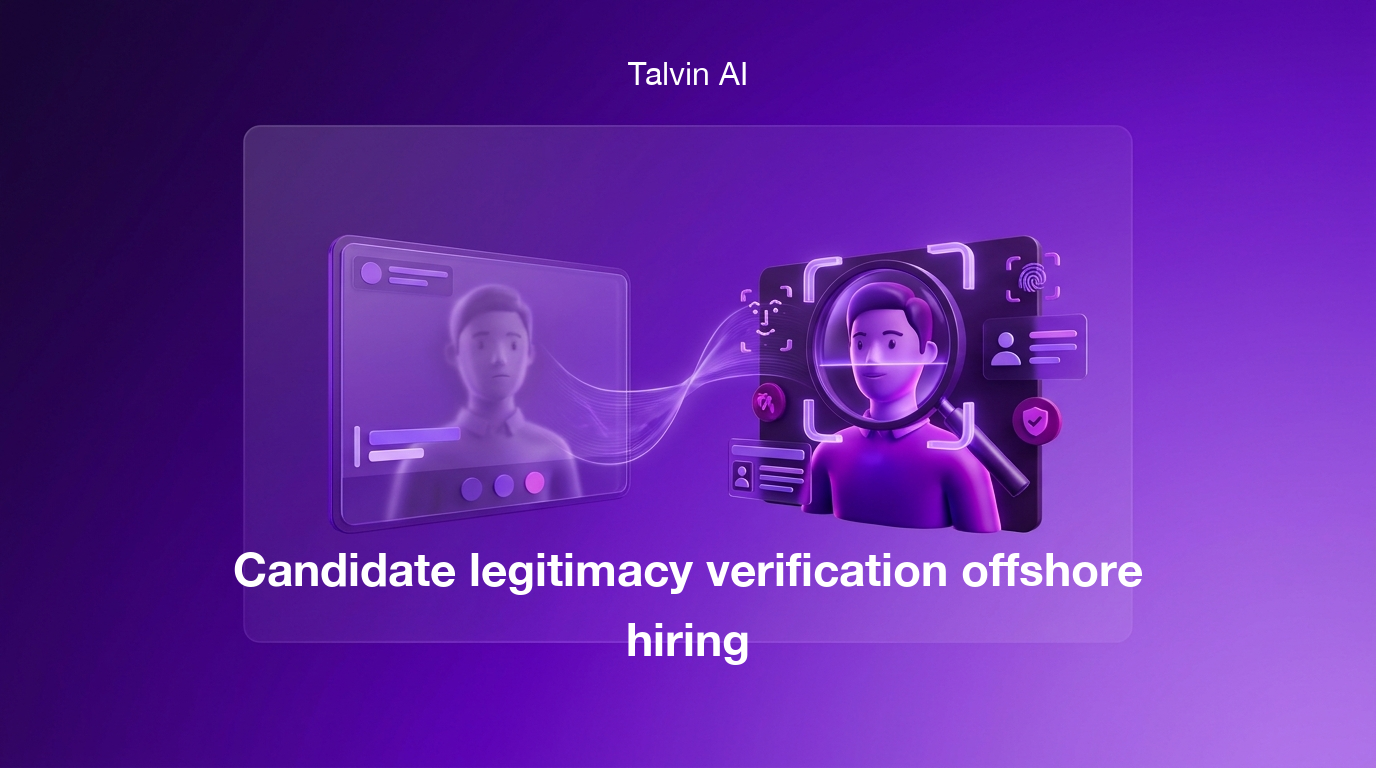
Candidate legitimacy verification is the process of confirming that the person being interviewed is the same person who will actually show up to do the job. For offshore staffing firms placing talent into clients they'll likely never meet in person, this has quietly become one of the highest-stakes parts of the screening process — because the interview is often the only moment anyone on the client side gets to assess the real human being behind the CV.
This isn't a theoretical risk. It's the specific failure mode that comes with distance: a strong candidate interviews, a different person shows up to work, and nobody notices until output drops or a client calls to complain. For a staffing firm whose entire business model is placing vetted humans, that single incident can cost more than a bad hire. It can cost the client relationship.
Why "Is This Candidate Even Real?" Has Become an Offshore Hiring Problem
Hiring across borders used to mean a resume, a reference check, and a video call where everyone assumed good faith. That assumption gets more expensive to hold the further apart the hiring manager and the candidate are — geographically, culturally, and in terms of who actually controls the interview environment.
Offshore staffing firms feel this more acutely than almost anyone else in recruiting, for a simple reason: screening isn't overhead for them, it's the product. A generalist recruiter in Colombo or Manila placing a backend engineer into a Sydney-based MSP often can't personally evaluate the technical answer — and if they also can't confirm who is actually answering, the risk compounds. One weak link and the client stops trusting every placement that follows.
The Specific Risk in Offshore Staffing (Not Generic Remote Work)
General "remote hiring fraud" content tends to talk about resume fraud or credential inflation. Offshore staffing has a narrower, sharper version of the problem: a candidate interviews well, gets placed, and a different person performs the role — sometimes a more experienced colleague sitting the interview as a favor, sometimes a deliberate substitution for higher-skill roles that command a premium placement fee.
For a staffing firm, this isn't an HR policy violation. It's a margin problem and a reputational one. The client isn't just losing a hire — they're losing confidence in every future candidate the firm sends them. That's the exact scenario the knowledge base's own research flags: a Singapore generalist recruiter screening a backend engineer for a Vietnam delivery centre can't always tell a genuinely strong answer from a confident-sounding one. Add the question of who is actually answering, and the exposure doubles.
Why Static, Async Screening Catches This Less Than People Think
A lot of offshore screening still runs on pre-recorded video assessments: the candidate gets a list of questions, records answers alone, on their own time, with no one watching in real time. It's efficient to administer. It's also the easiest format to game, because the environment is entirely unsupervised and the questions are fixed and knowable in advance.
| Screening approach | Can questions be anticipated? | Is the session supervised in real time? | Can a substitute realistically sit in? |
|---|---|---|---|
| One-way recorded video (fixed questions) | Yes — same list every time | No | Easier — no live follow-up to expose it |
| Live two-way adaptive voice interview | No — next question depends on the last answer | Yes, in effect — the AI probes in real time | Harder — a substitute has to improvise under live follow-up questions |
| Role simulation (Job Tryouts) | No — scenario responds dynamically | Yes — performance is observed as it happens | Hardest — requires sustained, live, situational judgment |
The pattern is consistent: the more static and predictable a screening format is, the easier it is to prepare for in advance or hand off to someone else. The more it adapts in the moment, the harder that becomes.
What a Verification-Resistant Screening Process Looks Like
Talvin AI's screening is built around live, two-way adaptive voice interviews conducted by Talvin's AI agent, Sally — not a pre-recorded video assessment. That distinction matters directly for legitimacy, for three specific reasons:
- The questions aren't fixed. Sally asks contextual follow-up questions and deliberate curveballs based on what the candidate just said. A substitute candidate can't prepare for a question list in advance, because there isn't one — the next question depends on the last answer.
- Optional video capture adds a visual check. The hiring organisation — not the candidate — decides whether to enable video recording during the interview. Most choose to enable it, because it adds a data point no voice-only tool provides: who is physically present and answering. This matters enormously when a staffing firm is placing remote offshore talent into clients who will never meet that candidate in person before day one.
- Built-in fraud prevention runs underneath the interview itself. Real-time video verification, activity monitoring, and one-time access links are part of the screening flow — so the session is tied to a specific candidate, at a specific time, through a link that can't be casually forwarded to someone else.
None of this requires treating video as a burden on the candidate. It's the opposite: seeing the candidate, combined with hearing how they think in real time, gives a staffing firm more to verify than a transcript or a recorded video alone ever could.
Configurable Drill-Down Depth: Catching the Confident-Sounding Wrong Answer
Legitimacy isn't only about whether the right person showed up. It's also about whether a recruiter who can't personally assess a technical skill can tell a genuinely strong answer from one that just sounds strong. Talvin lets recruiters configure how hard Sally probes on a given question — Low, Medium, or High drill-down — so a non-technical recruiter can set the AI to go deep exactly where it matters and lighter everywhere else.
That configuration is what turns a voice interview from a nice conversation into an actual filter. A candidate who memorised a correct-sounding answer tends to fall apart under a second or third follow-up question. A candidate who actually knows the material doesn't.
Job Tryouts: A Second Layer That's Even Harder to Fake
Job Tryouts places candidates inside realistic, role-specific scenarios powered by AI Persona Technology — dynamic, responsive virtual characters that simulate real workplace situations, like navigating a difficult customer interaction or resolving a complex objection in real time. Because the scenario responds to what the candidate actually does, there's no script to hand off to someone else, and no way to rehearse a fixed answer.
This was recognised with a Global Win at the VAPI Voice AI Hackathon specifically for this feature. Companies using Job Tryouts report a 30–45% reduction in employee turnover — a result that tracks with the core idea: a hiring decision grounded in demonstrated performance, rather than a rehearsed interview answer, tends to produce a better match to the actual job.
What This Looks Like in Practice
Dijital Team, an offshore staffing firm based in Sri Lanka placing talent into MSPs and IT service providers in markets like Australia, runs on exactly this logic: screening is cost of goods, not HR overhead. A bad or illegitimate placement doesn't just cost a candidate's salary — it costs the client relationship the whole business depends on. That's the clearest live example of why legitimacy verification sits inside the screening process itself, rather than as an add-on compliance step.
Code94 Labs, the engineering firm behind Talvin, used the platform on its own hiring and processed 488 resumes down to 15 candidates for final interviews in a single week. "We cut screening time by 80% and still hired better people," said Beenali Dangalle, Hiring Manager at Code94 Labs. "Talvin's voice assessments felt like having 10 recruiters working around the clock." That result came from the same mechanism described above: adaptive, live questioning that a recruiter doesn't have to sit through in person to trust.
Janashakthi Group, a Sri Lankan insurance and finance conglomerate, used Talvin to screen 150 candidates for a management trainee program in 5 days — a process that previously took 4–5 weeks manually. MAVI, a pre-vetted global finance and accounting talent provider, used Talvin at its highest-ever monthly rate charged by any customer in the company's history, for exactly this kind of high-stakes, trust-dependent placement work.
Building Legitimacy Checks Into Your Offshore Recruitment Process
For a staffing firm building or tightening up an offshore recruitment process, the practical sequence looks like this:
- Enable video capture on the interview, not just voice. It's optional, but it's the single highest-signal addition for legitimacy. Most organisations that try it keep it on.
- Use one-time access links, not reusable ones. Tying a session to a specific candidate at a specific time closes the easiest substitution route.
- Set drill-down depth to High on the skills your own recruiters can't personally evaluate. This is also where confident-sounding wrong answers get caught, not just substitutions.
- Add a Job Tryout for client-facing or senior roles. A live scenario is the hardest format to hand off to someone else.
- Review the interview transcript and video together before shortlisting, not just the score. The AI does the first pass; a human still makes the placement call.
None of this requires new headcount. Talvin's per-minute pricing — starting at the Startup tier and scaling through Growth and Business — is designed to be economically viable at placement volume rather than priced for enterprise budgets, which is the model that actually fits a staffing firm screening dozens or hundreds of candidates a year rather than a handful.
Frequently Asked Questions
What is candidate legitimacy verification in AI recruiting?
It's the process of confirming that the person being interviewed and evaluated is the same person who will actually perform the job. In remote and offshore hiring, where the hiring organisation may never meet the candidate in person before their start date, this typically combines live, adaptive questioning with optional video capture and session-level controls like one-time access links.
Can AI voice interviews be faked by a proxy candidate?
It's harder with a live, adaptive format than with a pre-recorded one. A fixed list of questions can be anticipated and handed to someone else in advance. A live interview where the next question depends on what was just said — combined with optional video capture — requires a substitute to improvise convincingly under real-time follow-up, which is a much higher bar.
How do staffing firms verify candidates for offshore placements?
The most effective approach combines three layers: a live, two-way interview that adapts in real time rather than using fixed questions; optional video capture so the hiring organisation can see who is actually present; and built-in session controls like one-time access links and activity monitoring to prevent the interview link itself from being passed to someone else.
Is video required for AI candidate screening, or is voice enough?
With Talvin, video is optional and the hiring organisation decides whether to enable it — not the candidate. Most organisations choose to enable it because it adds data a voice-only interview can't: visual presentation, culture-fit signals, and legitimacy verification. Talvin is not a video-only tool and not a voice-only tool — it combines adaptive voice conversation with optional video capture.
What's the difference between legitimacy verification and bias detection in AI hiring?
They solve different problems. Bias detection is about whether the evaluation itself is fair across candidates. Legitimacy verification is about whether the person being evaluated is who they claim to be. A platform can score fairly and still be vulnerable to a substituted candidate if it has no mechanism for confirming identity and presence during the interview.
How much does AI interview screening cost for high-volume offshore hiring?
Talvin uses a per-minute credit model layered under monthly subscription tiers, starting at the Startup tier and scaling up through Growth and Business, so cost scales with actual interview minutes used rather than a flat per-hire enterprise fee. Full details are on the pricing page.
See It on a Real Role
If your firm places candidates into clients who will never meet them before day one, legitimacy verification isn't a nice-to-have feature — it's part of what you're actually selling when you promise a vetted hire. Book a demo and run it against a role you're currently struggling to screen with confidence.