Let candidates speak. Talvin handles the volume.
Talvin replaces the manual phone screen with a live AI voice interview. Sally talks to every applicant, follows up on the weak answers, and returns a ranked shortlist with the reasoning behind it.
A better way to screen, assess and hire.
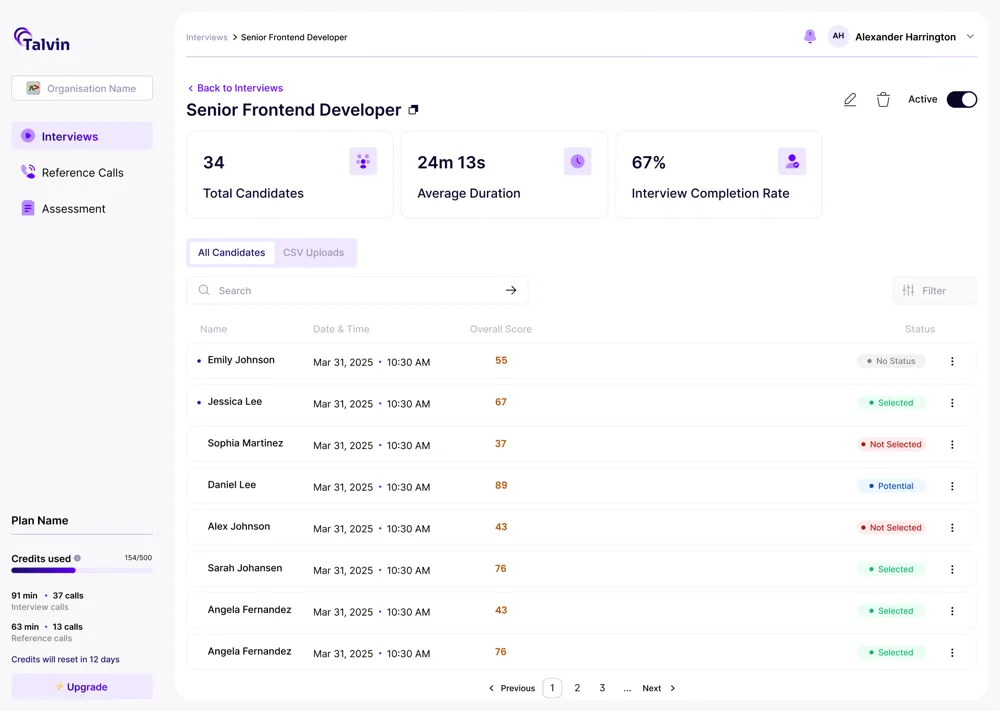
Access the full demo video
A recorded walkthrough of a real screening call, from the first question to the scorecard it produces.
From applicant to shortlist, without a phone call.



Most AI screening tools read from a script. Sally decides what to ask next.
Every serious platform in this category now does two-way voice. The difference is what happens when a candidate gives a vague answer.
A scripted tool moves to the next question. Sally notices the gap and pushes on it — the same thing a good recruiter does.
A fifteen-minute conversation can tell you more than a CV and a half-hour call.
| Capability | One-way video | Scripted chatbot | Talvin |
|---|---|---|---|
| Question flow | One-way videoFixed list, recorded alone | Scripted chatbotFixed branches | TalvinDecided live, from the answer |
| Follow-up questions | One-way videoNone | Scripted chatbotRule-based | TalvinContextual, plus deliberate curveballs |
| Probing depth | One-way video— | Scripted chatbot— | TalvinYou set it per question: low / medium / high |
| Non-native speakers | One-way videoTranscription degrades | Scripted chatbotText-only | TalvinBuilt for a global range of English |
| Video | One-way videoRequired | Scripted chatbotNone | TalvinOptional — you decide, not the candidate |
| Output | One-way videoA recording to watch | Scripted chatbotA transcript | TalvinScore, transcript and the reasoning |
Verifying skill is only half of it. Verifying the person is the other half.
AI can write a convincing CV in seconds. It can also sit beside a candidate during an interview. Screening at volume without checking who is actually on the call is how fabricated credentials reach an offer letter.
Every Talvin interview carries verification by default.
Read more on candidate fraud and verification →Built to scale with you — whatever the industry, function or volume.
Whether you're hiring ten people or ten thousand, Talvin adapts to the role. From frontline positions to technical ones, it assesses what actually matters — how candidates think, speak and solve problems.
Enterprise-grade hiring, built for scale.
From ATS integration to fraud prevention, Talvin is built for the complexity, compliance and volume of enterprise recruitment.


 +15
+15
- Encrypted in transit and at rest
- Always on
- Used to train our models
- Never
- Retention window
- You configure
“We cut screening time by 80% and still hired better people. Talvin's voice assessments felt like having 10 recruiters working around the clock.”
Everything you need to know
Still have questions? Talk to our team.
What is a Voice AI recruiter, and how does it work?
A voice AI recruiter conducts the first-round interview by phone or browser, in spoken conversation, and scores what the candidate says. Unlike a chatbot or a one-way video tool, it holds an actual back-and-forth.
With Talvin, the agent is Sally. She opens with the questions you've configured, listens, and decides what to ask next based on what she heard. If someone gives a confident but hollow answer about a project they supposedly led, she asks which part nearly went wrong. That follow-up is where most of the signal comes from.
You get back a score, the full transcript, and the reasoning behind the ranking — so any decision can be explained to a hiring manager or an auditor. Sally runs hundreds of these at once, and the four-hundredth candidate is assessed exactly as carefully as the first.
How is voice AI different from chat-based or text-based tools?
Voice carries information text cannot — how someone structures a thought under mild pressure, whether they hesitate on the part of their CV they were least prepared to discuss, and how they recover when a question doesn't go as expected.
There's also a practical problem with text screening in 2026: a candidate can paste a question into an AI assistant and return a polished answer in seconds. A live spoken conversation with unscripted follow-ups is considerably harder to fake in real time.
Voice is faster for the candidate too. Most people speak about three times faster than they type, so a fifteen-minute conversation surfaces more than a written assessment that takes forty minutes and feels like homework.
How secure is the data collected?
Candidate data is encrypted in transit and at rest — recordings, transcripts and the scores generated from them. The most important commitment is narrower: candidate data is never used to train our models.
Retention is configurable. You decide how long recordings and transcripts persist, and deletion requests can be honoured within your own workflow.
Talvin is built around GDPR and the frameworks governing the markets our customers hire in — Singapore's PDPA, Malaysia's PDPA, India's DPDP Act, Indonesia's UU PDP, Vietnam's Decree 13 and Sri Lanka's PDPA. A major financial institution put us through a full IT security review before approving enterprise rollout.
What types of questions does Sally ask?
Questions are built for the specific role, not pulled from a generic bank. Write them yourself, edit what Talvin generates from the job description, or mix both. Most are open-ended — problem-solving scenarios, role-specific technical questions and situational judgment prompts.
What matters more than the question list is the follow-up. On high drill-down, Sally pushes: asking for specifics, challenging vague claims, occasionally introducing a curveball the candidate could not have prepared for. That means a recruiter who isn't an engineer can run a credible technical screen.
Can Talvin integrate with our ATS?
Yes — more than 20 ATS platforms, including Ashby, Teamtailor, SAP SuccessFactors, Recruitee, Manatala, Greenhouse, Workable and Workday. Anything not natively supported can usually be reached through Zapier.
Talvin sits on top of your ATS rather than replacing it. Candidates are pulled from the roles you already have open, and completed interviews are written back to the candidate record. Invitations go out, reminders chase the people who haven't started, and follow-ups handle the no-shows.
Can voice AI replace human recruiters?
No, and it isn't designed to. What it removes is the repetitive first-round screening that consumes recruiter hours without using recruiter judgment. More than 70% of first-round conversations turn out to be with candidates who were never qualified.
What remains is the work recruiters are good at: assessing culture fit, selling the role, managing the hiring manager relationship, negotiating an offer, and choosing between two strong finalists. Teams typically report spending more time with the shortlist, not less — they simply arrive at it days earlier.
How does pricing work?
A monthly subscription with an allowance of interview time. Plans are shown as a number of interviews, calculated at roughly ten minutes each, and billed underneath as minutes — so a short screen uses less of your allowance and a deep technical interview uses more.
You're billed for interview time rather than per seat. Plans start at $175 a month, every tier includes AI interviews and Job Tryouts, and there's a 14-day money-back guarantee. See full pricing →
Can voice AI reduce bias in hiring?
It can reduce specific, well-documented sources of it. Every candidate gets the same questions, the same time and the same criteria, applied with the same attention at 9am and 6pm. Human screening drifts — interviewers get tired and are measurably influenced by names, accents, appearance and where someone studied.
The honest caveat: no AI system is automatically unbiased, and any vendor claiming otherwise is overselling. What matters is whether scoring is transparent enough to audit, whether criteria are role-relevant, and whether a human stays accountable for the decision.
How do you stop candidates cheating or using AI during the interview?
Two halves: is the person real, and are they being helped? Talvin verifies identity through real-time video, activity monitoring flags the signals that suggest someone is reading from another window or being coached, and every interview link is one-time use.
There's also a structural defence. Sally's follow-ups depend on what the candidate just said and aren't predictable in advance. Reading a generated answer aloud works for a scripted question; it falls apart when the next question probes a claim you made forty seconds ago.
How accurate is AI voice screening?
Three separate questions. Does it evaluate consistently? Yes — the same criteria applied the same way to every candidate. Do candidates engage honestly? Satisfaction averages 4.3 out of 5, collected after every completed interview rather than sampled.
Can you check its work? Every Talvin score comes with the transcript and the reasoning behind it. Scoring that can't be audited or exported should be treated with suspicion regardless of the accuracy claimed for it.
What if a candidate has a strong accent or isn't a native English speaker?
Speech recognition trained predominantly on North American English degrades on regional accents — and the damage isn't obvious. The transcript looks plausible, the score looks reasonable, and a well-qualified candidate is quietly ranked lower because the system misheard them.
Sally is built for the range of English candidates actually speak, with pacing tuned so a non-native speaker isn't rushed. Satisfaction of 4.3 out of 5 across a largely multilingual candidate base is the practical evidence.
Can candidates opt out of an AI interview?
Yes, and increasingly they expect the option. More than 70% of organisations now use AI somewhere in recruitment, and disclosure norms are tightening. You decide how the alternative is offered, and we provide disclosure language appropriate to each market you hire in.
Opt-out rates tend to be low when the interview is framed properly. Candidates object far less to being interviewed by AI than to being ghosted after applying.
Is video required?
No. Talvin is voice-led and video capture is optional — controlled by you, not the candidate. Most teams turn it on: it confirms the person interviewing is the person who applied, and adds a read on presentation. Turning it off doesn't reduce the assessment — the conversation, follow-ups, scoring and transcript work identically either way.
How long does setup take?
Most teams run their first interview the same day. Connecting your ATS is the longest step and usually takes under an hour. From there, configuring a role means importing the job description, reviewing the questions Talvin generates, and setting drill-down depth on the ones that matter. No implementation project, no professional services engagement.