The bottleneck isn't the candidate pool. It's recruiter hours.
Volume hiring rarely fails because there aren't enough applicants. It fails because there are too many, and the only way to tell them apart is a conversation nobody has time to have.
of first-round screening conversations turn out to be with candidates who were never qualified. You find out four minutes into the call.
of recruiter admin per hire — scheduling, reminders, follow-ups, chasing no-shows — before any actual evaluation happens.
is how long a strong candidate stays available. Miss the window and the offer goes to whoever moved faster.
shortlist forming, day 1 Manual first round
day 4–5
Two things break before anything else.
A single team runs requisitions across several countries at once — a delivery centre in one, a sales floor in another, engineers somewhere else again. Each market brings its own language range, salary expectations and interview availability, and headcount on the recruiting side rarely grows to match. One rigid screening process only fits whichever market it was designed around, and quietly under-serves the rest.
Screening a backend engineer for a team three time zones away, it is very hard to tell a strong answer from a confident-sounding one. The same applies to a compliance analyst, a clinical lead, or any role where the interviewer knows less about the work than the candidate does. The usual workaround is to push the problem onto a hiring manager, which is how a screening bottleneck becomes an engineering bottleneck.
Set it up once. It runs on every role after that.
Four steps. The first takes about an hour per role. The rest happen without you — including at 2am, in whichever market is awake.
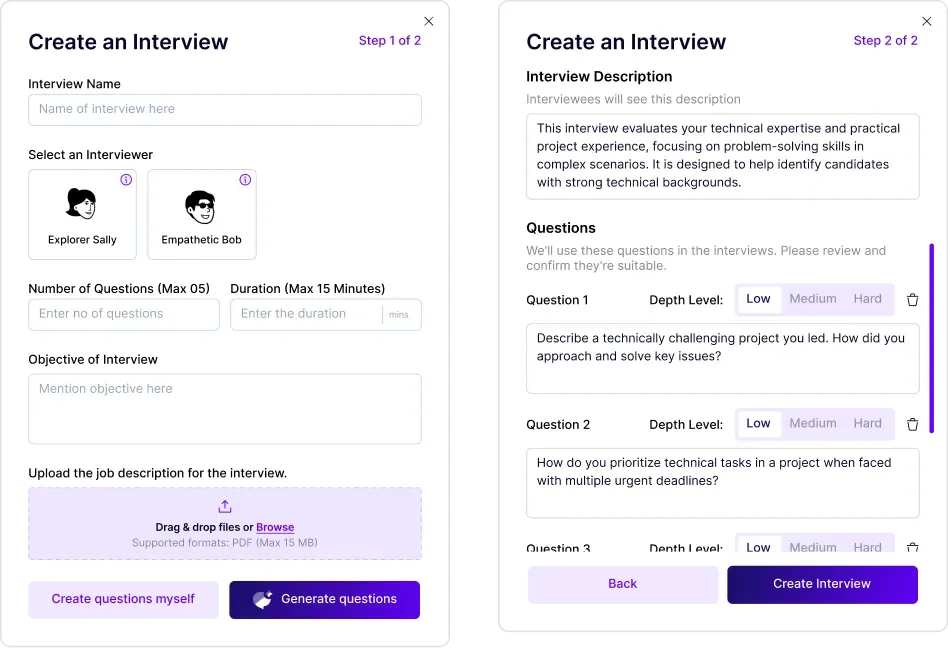
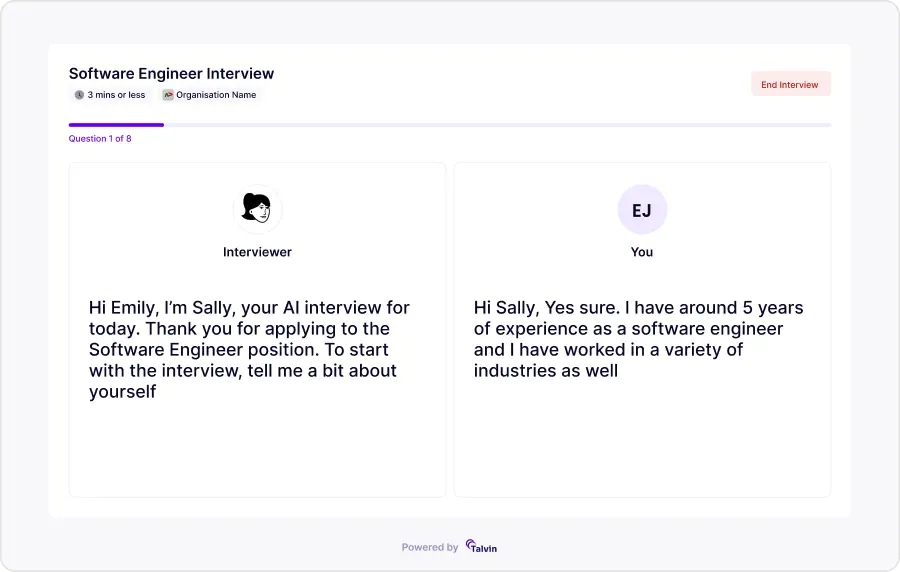
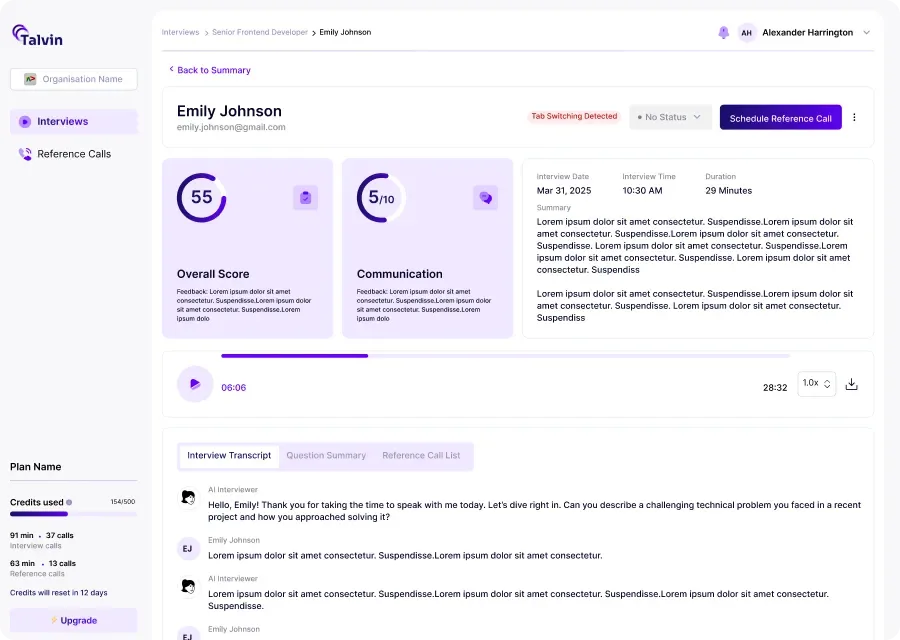
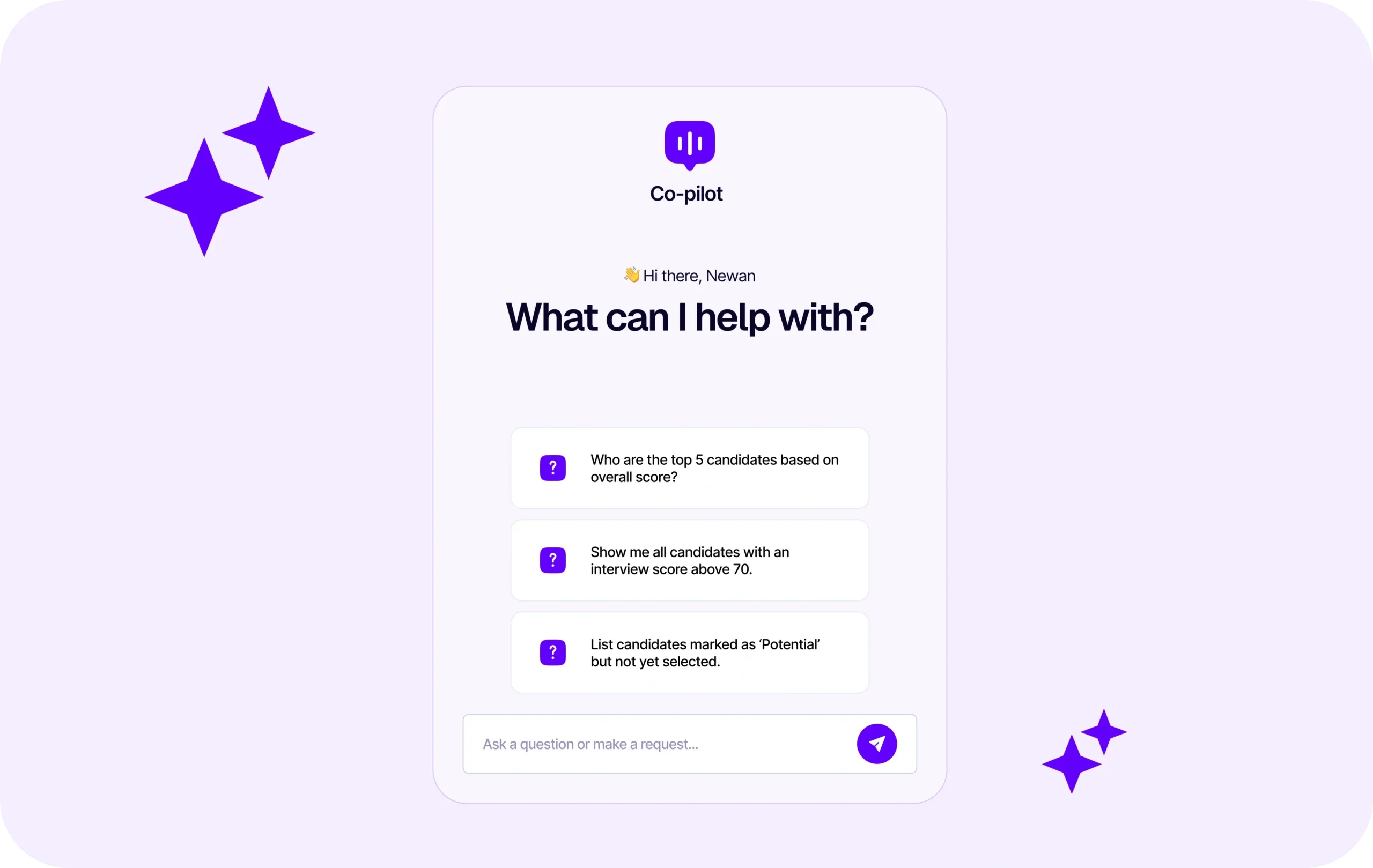
A shortlist your hiring managers will actually trust.
Results are written back to the candidate record in the ATS you already run. Nobody exports a spreadsheet or learns a second system.
Each candidate arrives with a score against your criteria, the full interview transcript, the reasoning behind the ranking, and optional video if you've enabled it.
That last part matters more than it sounds. A shortlist a hiring manager can interrogate — why is this person above that one? — gets acted on. A shortlist that arrives as a number gets second-guessed, and you end up re-screening manually.
A number can be argued with. Reasoning can be checked.
The four-hundredth candidate gets the same interview as the first.
Human screening drifts. Interviewers get tired, ask different questions of different people, and are measurably influenced by things that have nothing to do with the work. At ten candidates that variance is manageable. At five hundred it becomes the largest uncontrolled variable in your hiring.
Sally asks the same core questions, applies the same criteria and scores against the same bar at 9am on Monday and 6pm on Friday. Where a candidate's answer warrants a follow-up, she asks it — consistently, not depending on who happened to run the call.
Volume also stops requiring headcount. Whether a role attracts fifty applicants or five thousand, the screening capacity is the same.
Built to survive procurement.
The three questions your security, IT and legal teams will ask before anyone signs.
Candidate data — recordings, transcripts and scores — is encrypted in transit and at rest, and is never used to train our models. Retention is yours to configure. A major financial institution approved Talvin for enterprise rollout after a full IT security review.
Talvin sits on top of your existing ATS rather than replacing it. Candidates flow in, shortlists flow back, and invitations, reminders and follow-ups run automatically.
Built around GDPR and the data-protection frameworks governing the markets our customers hire in. Cross-border storage is where most vendors quietly struggle — a tool built solely for GDPR does not automatically satisfy the rest.
Questions from teams hiring at volume
The ten that come up on almost every enterprise call.
How many candidates can Talvin screen at once? +
There is no practical ceiling. Sally runs hundreds of interviews in parallel, and because candidates take them in their own time rather than at a scheduled slot, throughput isn't constrained by anyone's calendar.
The realistic limit is your own monthly plan allowance rather than the platform. Teams running a large intake usually size their plan around the peak month rather than the average, since volume hiring tends to arrive in spikes — two hundred roles for a new contact centre, or a graduate intake that lands entirely in one quarter.
What doesn't change with volume is the depth of each interview. The four-hundredth candidate gets the same questions, the same follow-up logic and the same scoring criteria as the first. That is the part that breaks in a manual process long before capacity does.
How long does it take to screen a few hundred applicants? +
Most of the elapsed time is candidates choosing when to take the interview, not Talvin processing them. Interviews are evaluated as they complete, so a shortlist builds continuously rather than arriving at the end.
In practice, teams tend to see the bulk of responses within the first two or three days of invitations going out, with reminders picking up most of the rest. One conglomerate screened 150 candidates in five days against a process that had previously taken four to five weeks.
The bigger shift is what your team does during that window. Instead of spending it running first-round calls, they spend it preparing for the interviews that matter.
Does the quality of assessment drop at volume? +
No, and this is the main argument for automating the stage at all.
Manual screening quality degrades predictably with volume. The tenth call of the day is not conducted with the same attention as the first, questions get shortened, and the evaluation becomes more instinctive as fatigue sets in. That variance is invisible in the output — every candidate still gets a yes or a no — which is precisely what makes it dangerous.
Automated screening has the opposite property: consistency is its natural state. The same criteria are applied with the same rigour regardless of how many candidates came before.
The trade-off is that the quality of the assessment depends entirely on how well the criteria were set up front. That is worth investing an hour in per role, and it is the part we'd push you on during a demo.
How do we keep screening consistent across different markets and roles? +
Consistency across roles comes from the criteria being explicit. Because you define what good looks like for each role and set the probing depth per question, the standard is written down rather than living in an individual recruiter's head. When a new person joins the team, the bar doesn't move with them.
Across markets, the thing that usually breaks consistency is language. Screening tools trained predominantly on one accent quietly under-score candidates who don't share it — the transcript looks plausible, the score looks reasonable, and a strong candidate is ranked lower because the system misheard them.
Sally is built for the range of English candidates actually speak, with pacing tuned so a non-native speaker isn't rushed. If you hire across several markets, this is worth testing directly with candidates from your own pipeline rather than a demo script.
Can a recruiter who isn't a specialist screen for a specialist role? +
This is one of the specific problems Talvin was built for.
A generalist recruiter screening a backend engineer, a compliance analyst or a clinical specialist is at a structural disadvantage: they cannot reliably distinguish a strong answer from a confident-sounding one, because they know less about the work than the candidate does. The usual workaround is to pass everyone to the hiring manager, which turns a screening bottleneck into an engineering one.
Because you set the drill-down depth per question, the probing logic doesn't depend on the interviewer's domain knowledge. Sally asks the follow-up regardless — challenging a vague claim, asking which part of a project nearly went wrong, pushing for specifics the candidate would only have if they'd actually done the work.
The hiring manager still makes the call. They just make it against a shortlist that has already been pressure-tested, rather than a stack of CVs.
What happens to the candidates we don't shortlist? +
They get a decision, which is more than most high-volume processes manage.
The default failure mode at scale is silence: a team receives four hundred applications, screens the first sixty, and the rest hear nothing. That is the single biggest driver of employer-brand damage in volume hiring, and it is entirely a capacity problem.
When every applicant is interviewed, every applicant can be responded to — and the ones who weren't right for this role can be assessed against the next one rather than disappearing.
Candidates also tend to prefer having been heard. Rating the experience 4.3 out of 5 after a process that didn't result in an offer is a meaningfully different outcome from being ignored.
How does this fit with our existing ATS and process? +
Talvin sits on top of your ATS rather than replacing it. Candidates are pulled from the roles you already have open, and completed interviews — score, transcript and reasoning — are written back to the candidate record where your team already works.
The automation runs end to end once connected: invitations go out, reminders chase the people who haven't started, and follow-ups handle the no-shows. Recruiters see a ranked shortlist rather than a queue of admin.
The lowest-risk way to introduce it is in parallel. Keep your current process untouched on one live role, run Talvin alongside it, and compare the two shortlists before changing anything.
How do we know the scoring is accurate? +
The answer that matters is that you can check it.
Every score comes with the full transcript and the reasoning behind the ranking. You can read exactly what a candidate said and why they placed where they did, which means a decision can be examined rather than assumed correct. Scoring that cannot be audited or exported should be treated with suspicion regardless of the accuracy a vendor claims for it.
Beyond auditability, the useful comparison is against the process being replaced rather than against perfection. The resume screen Talvin displaces has never been validated at all, and it currently sends more than 70% of first-round calls to candidates who were never qualified.
The practical test is to run Talvin alongside your existing process on one role and compare the shortlists. If the candidates it surfaces are people your hiring managers would have wanted to meet, that is a more meaningful validation than any figure we could publish.
What does it cost at our volume? +
Plans are an allowance of interview time, shown as a number of interviews and billed underneath as minutes. You're charged for interviews run, not for seats — so adding recruiters within your tier costs nothing extra.
That distinction matters at volume. Per-seat pricing charges you for headcount whether those people screen fifty candidates or five hundred, which is why it gets expensive for teams where several recruiters work the same requisitions.
The comparison worth running is against recruiter time. Take your recruiter's fully loaded hourly cost, multiply by the 7 to 9 hours of admin that goes into each hire, and multiply again by your monthly hires. That's the number the subscription is competing with — and for most teams running more than a handful of roles at once, it isn't close.
Plans start at $175 a month, and Enterprise pricing covers custom volumes, whitelabel branding and ATS integration options. If you tell us your expected monthly interview volume, we can size it precisely on a call. See full pricing →
How quickly can we get started? +
Most teams run their first interview the same day. Connecting your ATS is the longest step and usually takes under an hour.
There is no implementation project and no professional services engagement. If you'd rather test before committing, start on the free tier and put one live role through it.