Your Screening Is COGS, Not Overhead: The Margin Math of Offshore Placements
Introduction
If you run an offshore staffing firm, a recruitment process outsourcing (RPO) shop, or a BPO placing talent into US, UK, or Australian clients, you already know something most HR software vendors don't: screening isn't overhead for you. It's cost of goods sold.
A generalist recruitment agency can treat a slow screen as an inefficiency to tidy up someday. You can't. Every hour your team spends screening, and every placement that turns out to be a confident-sounding wrong answer rather than a genuinely strong one, comes straight out of your margin per placement. The client doesn't absorb that cost. You do.
This matters more right now because the category your buyers evaluate you against is getting noisier. AI interview vendors are racing to add cheat-detection layers and integrity add-ons because remote hiring at volume keeps exposing the same weak point: nobody can fully verify who's actually on the call. For an offshore staffing firm, that's not an abstract product-category trend. It's the exact risk sitting between your recruiter and your client's trust.
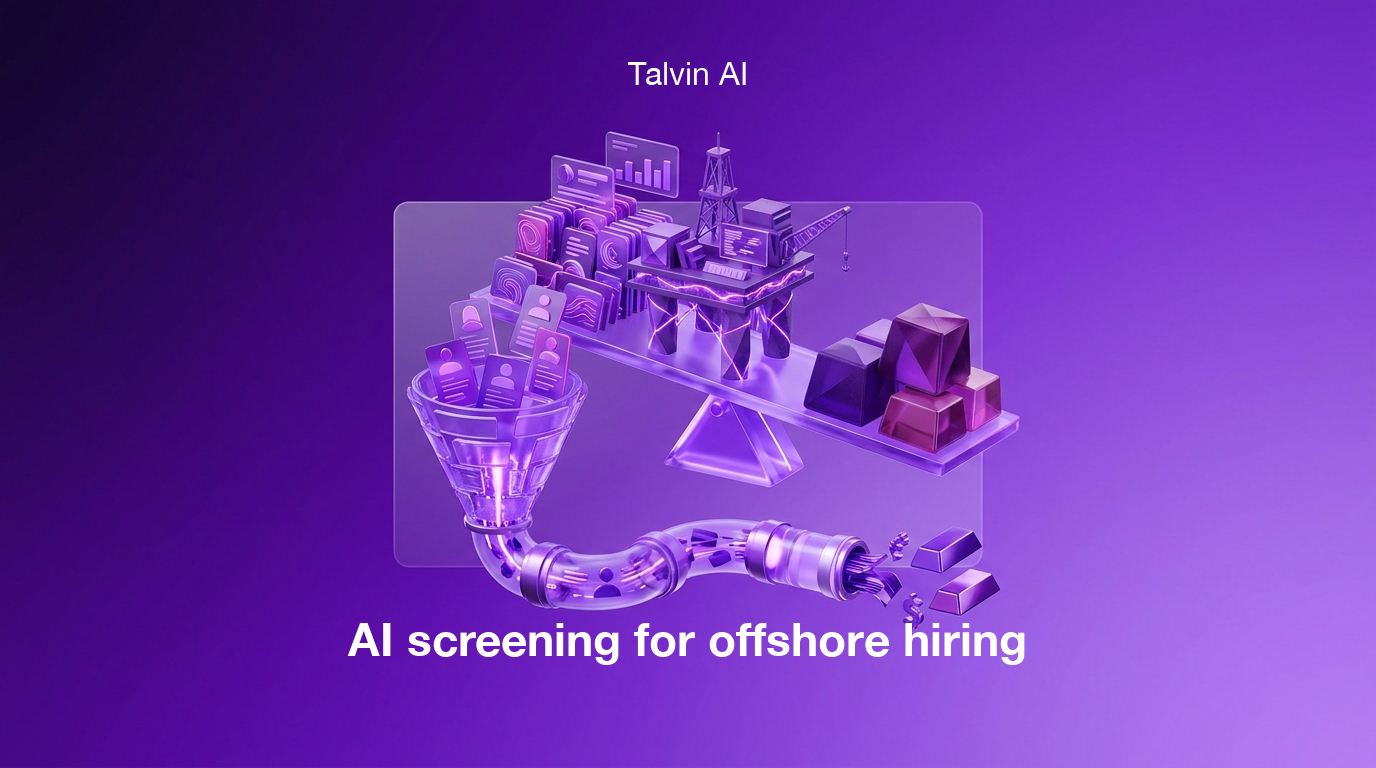
This guide walks through the margin math behind offshore screening, where it actually breaks, and how AI screening for offshore hiring changes the economics — not the admin.
Why Screening Is a Margin Line, Not an HR Line, for Offshore Staffing Firms
In a staffing or outsourced-delivery business, the deliverable is a vetted human being. Screening isn't the thing that happens before the real work starts — it is the production process. Get it wrong and you don't lose an afternoon of recruiter time. You lose a client relationship, and in offshore staffing, client relationships are the entire revenue base.
This is the structural difference between a staffing firm and most companies evaluating recruitment software. A bank or a university hires in bursts against an HR budget — a graduate intake, a restructuring — and when the burst ends, so does the spending. A staffing firm's hiring volume is tied directly to revenue: every placement made is revenue booked, and every placement that goes wrong is revenue at risk. That's why better screening isn't a nice-to-have for this segment. It's gross margin, directly.
The Pain Point Nobody Names Out Loud
Here's the scenario that plays out inside almost every offshore staffing firm placing technical talent: a generalist recruiter based in Colombo, Manila, or Bangalore is screening a senior Java engineer for a client's delivery centre in Vietnam, or a backend engineer for an MSP in Australia. The recruiter is excellent at assessing communication, reliability, and culture fit. They cannot tell a genuinely strong technical answer from a confident-sounding one.
That gap is invisible until a bad placement lands with the client. Then it's very visible, very fast, and very expensive.
The Margin Math: What a Bad Placement Actually Costs
Run the numbers the way a founder running an offshore staffing firm actually has to. Say your firm places a mid-level developer at a monthly placement fee, and your recruiter spends several hours sourcing, screening, and shortlisting that candidate before the client ever sees them. If the recruiter can't properly assess the technical answer and the candidate fails inside the first 90 days — a common clause in offshore placement contracts — you don't just lose that fee. You lose:
- The recruiter hours already sunk into sourcing and screening the failed candidate
- The replacement search, run under time pressure, usually at a discount or free-replacement term
- The client's confidence, which shows up later as a smaller next contract, not an invoice you can point to
None of that shows up as a single line item. It shows up as margin that quietly erodes placement by placement, which is exactly why it's so easy to under-price for and so hard to fix after the fact. The fix isn't hiring more recruiters — their time is billable, not overhead, so adding headcount doesn't improve the ratio. The fix is making the screening your current recruiters already do sharper, specifically on the dimension they can't naturally assess: technical depth.
What Changes the Math: Screening Depth You Can Actually Configure
This is the specific gap Talvin AI's voice interview platform is built to close. Talvin's AI interviewer, Sally, runs real-time, two-way adaptive voice interviews — not a pre-recorded video assessment, not a static question list. She asks contextual follow-up questions and deliberate curveballs based on what the candidate actually says, which is precisely the mechanism that catches a confident-sounding wrong answer before it reaches your client.
Configurable Drill-Down Depth: The Hero Feature for Non-Technical Recruiters
Recruiters can set a drill-down depth — Low, Medium, or High — per question. That means a non-technical recruiter can configure Sally to probe hard on the Java framework question a client specifically flagged as critical, while moving lightly through less decisive parts of the conversation. It directly answers the Singapore-recruiter-screening-a-Vietnam-engineer problem: your team doesn't need to become technical. The interview becomes technical on your behalf, to the depth you decide matters.
Optional Video Capture: Legitimacy Verification for Remote Placements
Placing remote offshore talent into a Western client who will likely never meet the candidate in person carries a specific risk: is the person on the call the person who'll show up on day one? Talvin's optional video capture — enabled at the hiring organisation's discretion — adds a visual data point on top of the adaptive voice conversation: candidate legitimacy verification, alongside the usual signals of presentation and culture fit. You get the adaptive conversation depth of a voice interview and the visual confirmation of a video one, in a single step.
APAC-Native Voice, Not a Retrofit
Sally is engineered for APAC accents and pacing, with a measured, neutral delivery designed to reduce friction for non-native English speakers — on both sides of the call, since many of your own recruiters and candidates are working in a second or third language. This matters because most international AI interview platforms are built around Western accents and pacing by default, which creates friction exactly where your placements live: Sri Lanka, India, the Philippines, Vietnam.
How It Fits Your Existing Workflow
Talvin doesn't ask you to rip out your ATS or your process. It integrates directly with Ashby, Greenhouse, Workday, and Zapier today, fetching candidates, triggering interviews, sending invites and reminders automatically, and returning a curated shortlist inside the tools you already run. For a firm where recruiters are billable, not overhead, the goal isn't to add another system to manage — it's to let the screening step run itself while your team focuses on the roles that need a human judgment call.
Why Per-Minute Pricing Fits a Placement Business Specifically
Talvin charges per minute of interview time, not per interview, starting at Growth ($325/month, 100 minutes included) and Business ($750/month, 250 minutes included) — see the full breakdown on the pricing page. For a firm placing dozens of candidates a month, this is the difference between a tool that scales with your placement volume and one that penalises you for screening thoroughly. One credit equals one minute, so an 8-minute technical screen plus a 10-minute culture-fit conversation is 18 minutes charged — not two separate line items against a per-seat cap.
Proof: Offshore Staffing Firms Already Running This
Dijital Team, an offshore staffing firm placing Sri Lankan talent into MSPs and IT service providers in Australia, runs on Talvin's Growth tier today. The reason they fit the model precisely: screening is their cost of goods, not their HR overhead — vetted talent is the product they sell, and better vetting is better margin per placement, not a process improvement they can defer.
MAVI, a firm supplying pre-vetted global finance and accounting talent, previously ran Talvin at its highest-ever self-serve monthly rate ($699/month) before later churning — evidence that the segment's willingness to pay for better screening scales with how seriously vetting is treated as production infrastructure, not an add-on.
Talvin's own team has run the same playbook internally. Code94 Labs, the product engineering firm behind Talvin, used the platform to screen 488 resumes down to a final shortlist of 15 candidates in one week. Their hiring manager, Beenali Dangalle, put it plainly: "We cut screening time by 80% and still hired better people. Talvin's voice assessments felt like having 10 recruiters working around the clock."
For a different proof point on how revenue-linked hiring responds to this model: World Business Lenders (WBL), a US non-bank lender with continuous phone-based sales and collections hiring, is Talvin's highest-value account to date and the only account in company history to expand from one tier to a higher one. It's a different segment — lending, not staffing — but the underlying logic is identical: when hiring volume is tied directly to revenue rather than an HR budget cycle, better screening pays for itself immediately, and customers in that position don't downgrade. They expand.
When to Fix Your Screening Process (The Trigger Points)
You don't need to overhaul your screening process on a theoretical timeline. These are the specific moments offshore staffing firms typically realise the current process is costing them margin:
- You've just won a new client contract that requires a fast ramp — "we need 20 developers by January" — and your current screening pace can't support it
- You're posting the same role repeatedly on LinkedIn or Indeed because candidates keep falling through at the client interview stage
- You've had a bad placement land publicly, or margin pressure has made every failed placement visibly more expensive
- You're expanding into a skill vertical your internal recruiters can't technically vet — a new programming language, a new regulated domain, a new seniority band
Any one of these is a signal the screening step needs to get sharper before the next contract, not after the next bad placement.
FAQ
Why is candidate screening considered cost of goods sold (COGS) for staffing agencies?
Because the deliverable a staffing firm sells is a vetted person, not a service wrapped around one. Every hour spent screening and every placement that fails is a direct cost against that specific sale — the same way raw materials are a direct cost for a manufacturer. It isn't administrative overhead that can be deferred; it's built into the cost of the thing being sold.
How does a bad offshore placement affect a staffing firm's margin?
A failed placement typically costs the firm the recruiter hours already spent on that candidate, the cost of running a replacement search (often under a free-replacement clause), and longer-term, a weaker client relationship that shows up as smaller future contracts rather than a single visible loss.
What's the difference between AI interview screening and traditional resume screening for offshore recruiters?
Resume screening relies on keyword matching against a static, self-reported document. An adaptive AI voice interview — like Talvin's Sally — asks real-time follow-up questions and probes answers to the depth a recruiter configures, which lets it test genuine competency rather than what a candidate wrote down.
Can AI interviews help verify candidate legitimacy for remote offshore placements?
Yes. Talvin's optional video capture, enabled at the hiring firm's choice, adds a visual data point — presentation, culture-fit signals, and legitimacy verification — alongside the adaptive voice conversation, which matters specifically when placing remote talent with a client who may never meet the candidate in person before day one.
What AI interview tool is built specifically for offshore staffing agencies?
Talvin AI is built for this segment specifically: configurable drill-down depth lets non-technical recruiters vet technical roles, per-minute pricing scales with placement volume rather than penalising thorough screening, and the voice engine is designed for APAC accents and pacing. See how it works for offshore hiring teams.
How does per-minute pricing work for AI candidate screening?
Talvin charges by the minute of interview time used, not per interview or per seat. One credit equals one minute. An 8-minute technical screen plus a 10-minute culture-fit interview is billed as 18 minutes total, which is what makes the model viable at placement volume rather than cost-prohibitive. Full tier breakdown on the pricing page.
Treat Screening Like the Margin Line It Is
If your recruiters can't technically assess what they're screening for, if the same role keeps getting re-posted, or if a single bad placement has already cost you a client relationship, the fix isn't more recruiter hours. It's sharper screening at the step where the gap actually sits.
Book a demo and see how configurable drill-down depth, adaptive voice interviews, and optional video capture change the margin math on your next placement. You can also explore Job Tryouts for roles where demonstrated performance matters as much as the interview itself.