Talvin vs Fuku AI: Voice-First vs Video-First Hiring for APAC
Introduction
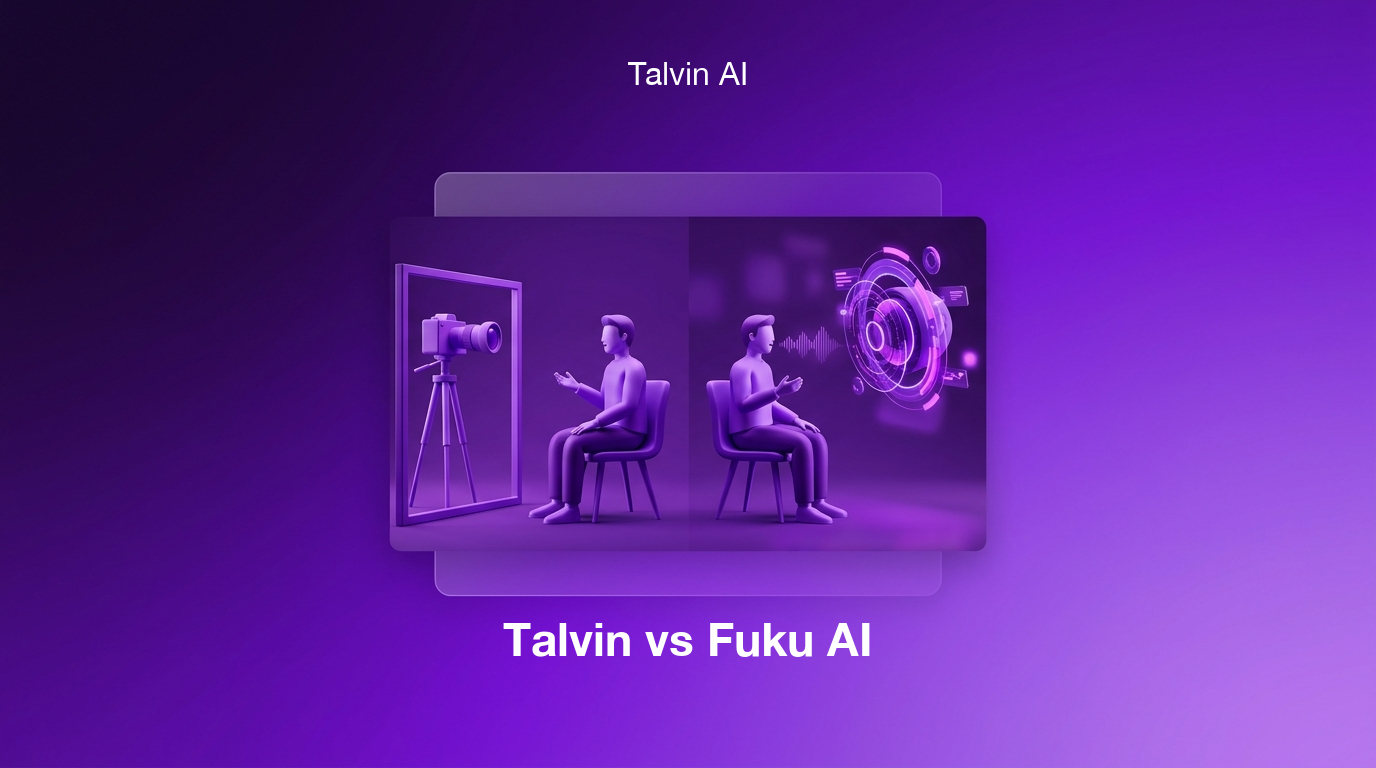
Talvin vs Fuku AI comes down to one structural question: do you want a candidate answering pre-set questions on camera, or do you want an AI that actually listens and probes based on what the candidate says? Fuku AI, a Singapore-based platform, markets itself as an 'AI hiring operating system designed primarily for APAC hiring teams' — built around a structured video AI interviewer called Fiona, plus unified WhatsApp, LinkedIn, and email outreach. Talvin AI takes a different route: two-way adaptive Voice AI interviews (powered by an agent named Sally), with optional video capture layered on top.
Fuku is the first APAC-native challenger to build an all-in-one hiring OS positioned the way Talvin has positioned itself for two years. That overlap is exactly why this comparison matters now. If you're evaluating a Fuku AI alternative for high-volume APAC hiring, here's what the two platforms actually do differently.
What Fuku AI Actually Is
Fuku AI positions itself as a full-funnel hiring platform for APAC teams: sourcing, multi-board job posting, candidate matching, and a structured video interviewer named Fiona. It also bundles outreach across WhatsApp, LinkedIn, and email into one workflow, with a Growth plan referenced publicly around US$499/month. Fuku has published more than 20 comparison pages against regional incumbents like JobStreet, Glints, FastJobs, Manatal, Workable, and HireVue — showing it's actively building share in the same APAC SMB and mid-market segment Talvin serves.
What Fuku has not published is any public data on funding, launch date, or how Fiona performs across the accent and language diversity that defines APAC hiring — Filipino English, Sri Lankan English, Indian English, Bahasa-influenced English, and more. Fiona's interview format is also video-first and structured, which means candidates respond to fixed or lightly varied questions on camera rather than engaging in a real-time adaptive conversation.
Talvin vs Fuku AI: Side-by-Side Comparison
| Capability | Talvin AI | Fuku AI |
|---|---|---|
| Interview modality | Two-way adaptive Voice AI (Sally) + optional video capture | Structured video AI interviewer (Fiona) |
| Adaptive follow-ups / curveballs | Yes — configurable drill-down depth (Low/Medium/High) per question | Not publicly documented |
| Job Tryouts / role simulations | Yes — realistic scenario-based simulations, VAPI Global Voice AI Hackathon winner | Not offered |
| APAC accent/localisation engineering | Purpose-built for regional accents and linguistic diversity | Not publicly documented |
| WhatsApp outreach | Coming Q2 2026 (High-Value Signal matchmaking) | Live — part of unified outreach |
| Multi-channel outreach (LinkedIn, email) | Via ATS automation (invites, follow-ups, reminders) | Live — WhatsApp + LinkedIn + email bundled |
| ATS integrations | Ashby, Greenhouse, Workday, Zapier (live); Teamtailor in development | Not Talvin's focus area — Fuku leans on multi-board posting |
| Pricing model | Per-minute credit system — plans from $175/mo (50 min) | ~US$499/mo reference price (Growth plan) |
| Enterprise/whitelabel | Available on Enterprise tier | Not publicly documented |
Talvin's Specific Advantages — Tied to Real Hiring Problems
1. You Can't Assess Judgment From a Recorded Video Answer
Resumes are static, and so is a pre-set video question. Industry data shows over 70% of screening interviews are conducted with candidates who turn out to be unqualified — a problem that video-only platforms don't solve, because they can't follow up on an answer that doesn't quite add up. Talvin's Sally asks contextual follow-up questions and deliberate curveballs in real time, which is what actually verifies technical skill and situational judgment rather than rehearsed delivery. This is also what lets non-technical recruiters confidently screen technical roles — something a static video format can't replicate.
2. Video Alone Measures How Someone Interviews, Not How They Work
Fiona's structured video format, like most video AI tools, measures interview performance. Talvin's Job Tryouts go further by placing candidates inside realistic, role-specific scenarios — a difficult customer interaction, a technical objection — so hiring decisions are grounded in demonstrated performance. Companies using Job Tryouts report a 30-45% reduction in employee turnover. This feature won the VAPI Global Voice AI Hackathon, recognised specifically for the realism of its role simulations.
3. To Be Clear: Talvin Isn't 'Anti-Video'
Talvin isn't a voice-only platform competing against a video-only one on a single axis. Talvin's hiring organisations can optionally enable video capture of the candidate alongside the voice interview — most do, because it adds visual presentation, culture-fit signals, and candidate legitimacy verification on top of the adaptive conversation. The difference with Fuku isn't 'voice vs video' as a binary. It's that Talvin gives you the adaptive, real-time conversational depth AND the visual data point, while Fiona gives you the visual data point without the adaptive depth.
4. Accent Robustness Is Still an Unproven Claim for Most APAC Tools
Fuku markets itself as built 'primarily for APAC hiring teams,' but it hasn't published any data on how its video AI performs across the region's accent diversity. Talvin's agents are engineered specifically for APAC — measured pace, neutral accents calibrated for non-native English speakers — because a platform that can't parse a Sri Lankan, Filipino, or Indian English accent accurately isn't actually APAC-native, regardless of where it's headquartered.
5. Economics That Scale With Volume, Not Against It
Fuku references a Growth plan around $499/month. Talvin's per-minute credit system starts at $175/month for 50 minutes and scales to $750/month for 250 minutes on the Business tier, with Enterprise custom pricing for unlimited volume plus whitelabel and ATS integration. Because Talvin charges per minute of interview time rather than per interview, companies can increase screening volume without the cost becoming prohibitive — critical for the 25+ hires/quarter threshold where manual screening breaks down entirely. See the full breakdown on the Talvin pricing page.
Who Should Switch (And Who Shouldn't)
If your hiring volume is light — fewer than 25 hires per quarter — either platform's overhead may be more than you need, and a simpler ATS workflow might suffice. If multi-board job posting across regional job boards is your primary pain point, Fuku's breadth there is a legitimate strength worth evaluating.
But if your bottleneck is screening quality at volume — too many resumes, not enough signal on who can actually do the job, and recruiters who can't technically vet every candidate — Talvin's adaptive voice interviews and Job Tryouts are built specifically for that problem. This is especially true for conglomerates, banking, insurance, technology, and hospitality employers hiring across multiple roles simultaneously, and for offshore and BPO teams where accent-robust screening at scale is non-negotiable.
Real APAC Results With Talvin
Janashakthi Group, a Sri Lankan conglomerate, used Talvin to screen 150 candidates across multiple roles in 5 days — a process that previously took 4-5 weeks manually.
Sampath Bank PLC, a major Sri Lankan financial institution, ran a successful initial pilot that secured Board IT approval for an enterprise-wide rollout — demonstrating Talvin can meet rigorous financial-sector security and compliance standards.
Mindvalley, a global EdTech company, completed a successful strategic pilot and is moving toward full-scale implementation.
At JXG, Talvin processed 460+ applications for a management trainee program, completed 96 automated AI interviews, and narrowed the field to the top 2% of talent for a final shortlist of 10 candidates. Rehan Perera, Senior Assistant Manager – HR at JXG, described the process as '100% transparent and data-driven.' At Code94 Labs, Talvin's own builder, 488 resumes were narrowed to 15 final-round candidates in a single week, cutting screening time by 80%.
Explore how this works in practice on the AI Candidate Screening and Job Tryouts pages.
Frequently Asked Questions
Is Fuku AI a good HireVue or Talvin alternative for APAC hiring?
Fuku AI is a legitimate APAC-focused hiring platform with multi-board posting and unified outreach. It's a reasonable fit if sourcing breadth across job boards is your priority. If your core need is adaptive, high-signal screening at volume, Talvin's voice-based approach is built specifically for that.
What's the difference between Talvin AI and Fuku AI?
Talvin runs two-way adaptive Voice AI interviews with optional video capture and real-time follow-up questions. Fuku's Fiona runs structured video interviews. Talvin also offers Job Tryouts (role simulations), which Fuku does not currently offer.
Does Talvin AI offer WhatsApp sourcing like Fuku AI?
Talvin's WhatsApp sourcing and matchmaking feature is coming in Q2 2026, designed to surface High-Value Signals — motivations, career goals, and soft skills beyond a CV — for precise candidate-company matching. Fuku currently offers WhatsApp as part of its live outreach bundle.
Which platform is cheaper, Talvin AI or Fuku AI?
Talvin uses a per-minute credit model starting at $175/month for 50 minutes, scaling to $750/month for 250 minutes on the Business tier, with custom Enterprise pricing. Fuku references a Growth plan around $499/month. The better value depends on your interview volume and minutes needed — see Talvin's pricing page for details.
Can Fuku AI or Talvin AI handle offshore and BPO hiring in the Philippines, India, or Sri Lanka?
Talvin is engineered specifically for APAC accents and linguistic diversity, which matters directly for offshore and BPO hiring where non-native English speakers make up the majority of applicants. Fuku has not published specific data on accent performance. See Talvin's offshore hiring page for more detail.
Does Fuku AI offer Job Tryouts or role simulations?
No. Job Tryouts — realistic, role-specific scenario simulations that measure demonstrated performance rather than interview performance — are a Talvin-specific feature. Companies using Job Tryouts report a 30-45% reduction in employee turnover, and the feature won the VAPI Global Voice AI Hackathon.
Conclusion
Talvin vs Fuku AI isn't a simple voice-vs-video debate — it's a question of what gives you more signal before you make a hiring decision. Fuku's structured video interviewer and bundled outreach are worth evaluating if sourcing breadth is your main gap. But for teams that need adaptive, follow-up-driven screening at volume, accent-robust performance across APAC's linguistic diversity, and role simulations that predict on-the-job performance rather than interview performance, Talvin AI is built for exactly that problem.
Hiring 25+ people a quarter and tired of guessing whether video answers reflect real competency? Book a demo and see how Talvin's Voice AI interviews and Job Tryouts compare for your team.