
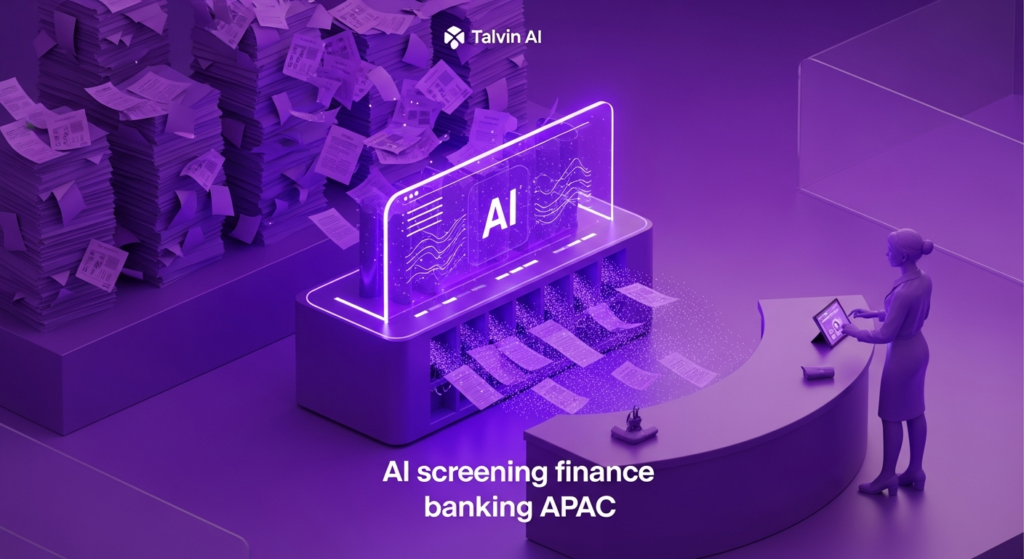
How AI Screening Transforms Finance & Banking Hiring in APAC
AI screening is changing how finance and banking institutions across APAC hire — and it’s happening faster than most HR teams expected. The pressure is real: regulatory complexity, high application volumes, and the constant risk of a bad hire in a compliance-sensitive role. Manual screening processes that worked five years ago are now a liability. The candidates you want are off the market within days. The ones who make it through a slow funnel are often not the ones you needed.
This guide covers what AI screening actually does in the context of finance and banking hiring, where it delivers the clearest return, and what the evidence looks like from institutions that have already made the shift.
The Specific Problem Finance and Banking Recruiters Face in APAC
Hiring in financial services is not the same as hiring for a tech startup or a logistics company. The stakes per hire are higher. The regulatory context demands more rigorous screening — you cannot put someone in a client-facing or compliance role on the basis of a strong CV and a gut feeling. And in APAC specifically, you are often hiring across markets with different linguistic backgrounds, different educational credentialing systems, and different norms around how candidates present themselves.
The result is a process that is inherently slow. Recruiter time gets absorbed by high volumes of applications — over 70% of screening interviews are conducted with ultimately unqualified candidates. That is not an edge case. That is the default state of most financial institution hiring funnels in this region.
The compounding problem: top candidates in finance — credit analysts, relationship managers, compliance officers, tech talent for fintech teams — are not sitting idle waiting for a 4-week process to resolve. They receive and accept offers faster than most enterprise recruitment timelines can move.
Why Traditional Screening Falls Short Here
- CV-first filtering misses competency. A resume tells you where someone worked and what they claim to have done. It tells you almost nothing about how they reason through a credit risk scenario or handle a difficult client conversation under pressure.
- Phone screens are a bottleneck. Recruiters at financial institutions spending 6.5 to 9 hours on admin work per placement cannot run fifty meaningful screening calls a week. Something gets cut — usually the depth of the conversation.
- Non-technical HR teams struggle with technical roles. A generalist recruiter assessing a candidate for a fintech product role or a data analytics position in a banking team is operating without the domain knowledge to probe effectively. They default to surface-level questions and rely on manager interviews to do the heavy lifting — which delays the process further.
- APAC linguistic diversity creates scoring inconsistency. Candidates across Singapore, Malaysia, Sri Lanka, India, and Indonesia come with different English fluency profiles. A manual screening conversation conducted by different recruiters on different days produces inconsistent results that are difficult to compare or defend.
What AI Screening Actually Does — And What It Doesn’t
AI screening in the context of APAC finance and banking hiring means replacing the initial unstructured phone screen with a structured, two-way AI-driven voice interview. Every candidate gets the same questions, asked in the same way, with the same follow-up logic applied based on their responses.
This is not a chatbot asking candidates to type answers into a form. Talvin’s AI agent, Sally, conducts real-time adaptive voice conversations — asking follow-up questions based on what the candidate actually says, probing deeper on technical competencies where configured to do so, and flagging inconsistencies between what someone claims and how they reason through a scenario in real time.
Recruiters configure the depth of probing per question: low, medium, or high. For a compliance officer role, you might set high drill-down depth on regulatory knowledge questions and medium depth on communication skills. For a frontline relationship manager, the configuration shifts accordingly. The AI adapts to the candidate’s answers within that framework — it is not playing back a script.
Optional video capture of the candidate is available and most hiring organisations choose to enable it. This gives you the visual data point — how the candidate presents, their composure, cultural fit signals — alongside the adaptive voice conversation. You get more information than any pure video platform can offer, because you are not just watching someone answer static questions. You are watching them think in real time.
What It Does Not Replace
AI screening at the top of the funnel is not a replacement for human judgment at the decision point. It is a filter. It gets you from 300 applicants to a shortlist of 20 that a senior recruiter or hiring manager can engage with meaningfully. The technical interview, the panel discussion, the reference check — those remain. What changes is that by the time a human is in the room, the obvious mismatches have already been removed, and the conversation can focus on the nuances that actually require human judgment.
AI Screening in Financial Institutions — What the Evidence Shows
Sampath Bank PLC, one of Sri Lanka’s major financial institutions, ran a pilot with Talvin AI under the kind of security and compliance scrutiny you would expect from an enterprise bank. The result was not just a successful pilot — it secured Board IT approval for an extended enterprise-wide implementation. That level of institutional sign-off reflects what the evidence showed: the platform could meet rigorous financial sector requirements while delivering meaningful efficiency gains.
The Janashakthi Group pilot — another APAC conglomerate operating in financial services among other sectors — screened 150 candidates in 5 days. That same process had previously taken 4 to 5 weeks manually. The timeline compression was not achieved by cutting corners on assessment quality. It was achieved by removing the scheduling overhead, the no-show gap, and the recruiter bottleneck that make manual screening slow.
JXG processed 460 applications for a management trainee programme, completed 96 automated AI interviews, and produced a final shortlist of 10 candidates for their senior assessment round. Their HR team described the process as 100% transparent and data-driven. That transparency matters in financial services, where hiring decisions may need to be audited or explained.
The Compliance Question — And Why It Matters More in Finance
Finance and banking HR teams thinking about AI screening have a legitimate question that other industries ask less often: what does this mean for our compliance obligations?
There are a few dimensions to this.
Consistency as a Compliance Advantage
Manual screening introduces variation that is hard to document and harder to defend. When different recruiters conduct phone screens on different days in different ways, you have no structured record of why one candidate progressed and another did not. AI screening produces a consistent, documented interaction for every candidate — same questions, same probing framework, structured output. That is not just more efficient. It is more defensible.
Bias Reduction Through Structured Assessment
The AI evaluates candidates against the same criteria, applied consistently. It does not have a good day or a bad day. It does not form a snap impression based on an accent in the first thirty seconds of a call. For APAC institutions hiring across diverse linguistic and cultural backgrounds — Singaporean candidates alongside Indian, Malaysian, and Sri Lankan candidates applying for the same role — this consistency matters for both fairness and institutional risk management.
Data Security
Talvin’s infrastructure is built on enterprise-grade cloud architecture with all candidate data encrypted at rest and in transit. The platform is GDPR compliant, uses SOC2-compliant identity management, and operates under a strict policy that candidate PII is never used for model training. For financial institutions with data governance requirements, these are not optional considerations.
Specific Use Cases in Finance and Banking Hiring
Relationship Manager and Client-Facing Roles
The ability to communicate clearly under pressure, handle objections, and represent the institution professionally — these are hard to assess from a CV and inconsistently assessed in a rushed phone screen. AI voice interviews surface how a candidate actually communicates in a structured conversation, not just whether they can describe their experience in a well-formatted document.
For client-facing roles at scale — graduate intake programmes, branch network hiring, relationship manager cohorts — AI screening handles volume that a human team cannot. Top candidates drop off within 48 hours if not contacted quickly. An AI screening system that runs 24/7 and responds to applicants immediately removes the delay that costs you strong candidates to faster-moving competitors.
Technical and Fintech Roles
One of the clearest advantages of configurable AI screening is the ability to empower non-technical recruiters to vet technical talent. A generalist HR team member does not need to know how to evaluate a data engineer’s SQL proficiency from first principles — the AI can be configured with the right technical questions, set to high drill-down depth, and structured to probe inconsistencies in a candidate’s claimed experience. The recruiter reviews the output, not the raw conversation.
Compliance and Risk Roles
For roles requiring specific regulatory knowledge — AML, KYC, credit risk, audit — the AI can be configured to ask scenario-based questions that test applied knowledge rather than textbook recall. The follow-up logic catches candidates who have memorised the right terminology without the underlying understanding. Sally asks curveball questions deliberately designed to probe the boundary between rehearsed answers and genuine competency.
High-Volume Graduate and Trainee Programmes
Management trainee and graduate intake programmes are where the volume problem is most acute. Hundreds of applications arrive in a short window. The shortlist needs to be produced quickly. AI screening handles this without adding headcount to the TA team. The JXG example — 460 applications, 96 interviews completed, top 2% identified, 10-candidate shortlist produced — demonstrates what this looks like in practice for a structured programme hiring across a competitive applicant pool.
ATS Integration — No Process Overhaul Required
A common concern from banking and financial institution HR teams is system complexity. They are often operating within procurement-approved HRIS and ATS environments that cannot be replaced or significantly modified without a lengthy approval process.
Talvin integrates directly with existing ATS platforms — currently live with Ashby, Greenhouse, Workday, and Zapier. The system fetches candidates from the ATS, triggers interviews, sends invitations and reminders automatically, and returns a structured shortlist within the client’s existing tools. There is no rip-and-replace. The workflow sits on top of what is already there.
For enterprise financial institutions with custom requirements, the Enterprise tier includes full ATS integration options, unlimited users, and white-label branding — so the candidate-facing experience reflects the institution’s own identity, not a third-party vendor’s.
See pricing and plan options →
What to Expect When You Implement AI Screening
The efficiency gains are front-loaded. The biggest change most financial institution HR teams notice first is the reduction in time spent on the early screening stage — not because the process gets shorter, but because the bottleneck moves. Recruiters stop spending their hours on calls with candidates who were never going to progress. They start spending their time on conversations that actually matter.
Candidate satisfaction tends to hold or improve. Talvin’s average candidate satisfaction rating across all interviews is 4.2 out of 5. Candidates who receive a fast, structured, professional screening experience — even one conducted by an AI — report it positively. The alternative, from the candidate’s perspective, is often a week of silence followed by a rushed 15-minute phone call from a recruiter who has clearly not read their application.
The quality of the shortlist improves because the filter is applied consistently. When a hiring manager reviews 15 candidates who all passed the same structured screening framework, the comparison is more meaningful than reviewing a mix of candidates who came through different recruiters on different days with different questions.
For companies using Job Tryouts — Talvin’s role simulation feature — the evidence points to 30 to 45% reduction in employee turnover. In financial services, where a bad hire in a client-facing or compliance role carries significant institutional risk, that outcome is worth taking seriously.
Frequently Asked Questions
Can AI screening handle the volume of a large banking graduate intake programme?
Yes. Talvin runs hundreds of simultaneous interviews, 24/7. A programme receiving 400 applications in a two-week window can have all candidates screened and shortlisted within days rather than weeks. JXG processed 460 applications and produced a 10-candidate shortlist using AI screening for their management trainee programme.
Is AI screening compliant with financial sector data governance requirements?
Talvin operates with all candidate data encrypted at rest and in transit, SOC2-compliant identity management, GDPR compliance, and a strict policy against using candidate PII for model training. Sampath Bank PLC, a major Sri Lankan financial institution, completed an enterprise pilot that secured Board IT approval for full rollout — reflecting the platform’s ability to meet institutional compliance standards.
How does AI screening handle non-native English speakers applying for finance roles in APAC?
Talvin’s AI agent is engineered specifically for APAC linguistic diversity — built with measured pacing and accents calibrated for the region. This is a documented weakness of Western AI platforms applied to APAC hiring. Talvin was purpose-built for markets like Singapore, Malaysia, India, Sri Lanka, Vietnam, and Indonesia.
Can non-technical HR recruiters use AI screening to assess technical finance roles?
Yes. This is one of the explicit design goals of the platform. Recruiters configure the questions and set the drill-down depth per topic. The AI conducts the technical probing and returns a structured assessment. A generalist recruiter does not need domain expertise to run a meaningful first-round screen of candidates for a credit risk or fintech engineering role.
How long does a typical AI screening interview take for a banking role?
Interview length depends on configuration. Talvin charges per minute of usage — not per interview — so there is no arbitrary time cap. The platform is designed to let you run the interview for as long as the role warrants. An 8-minute technical screen and a 10-minute culture-fit conversation are charged at 18 minutes total.
Does AI screening integrate with the ATS systems financial institutions typically use?
Talvin is currently live with Ashby, Greenhouse, Workday, and Zapier. The system fetches candidates automatically, triggers interviews, handles invitations and reminders, and returns shortlisted candidates within the existing ATS workflow. Enterprise plans include custom ATS integration options for institutions with specific system requirements.
What happens to candidates who drop off during an AI screening process?
Talvin’s automation layer handles follow-up reminders automatically. Candidates who do not complete their interview receive reminders without any manual recruiter intervention. This reduces drop-off without adding to recruiter workload.
The Bottom Line for APAC Finance and Banking HR Teams
AI screening in finance and banking is not a speculative future capability. Institutions across APAC are already using it to cut screening timelines from weeks to days, reduce the proportion of unqualified candidates reaching interview stage, and produce shortlists that are more consistent and more defensible than those produced through manual processes.
The Sampath Bank enterprise rollout, the Janashakthi Group pilot, and the JXG management trainee programme all point in the same direction: the technology works at financial sector scale, meets institutional compliance requirements, and delivers the efficiency gains the numbers suggest it should.
If your team is still running a 4-to-5-week screening process for a role that needs to be filled in two, the problem is not the talent market. It is the process.
See How AI Screening Works for Finance and Banking Hiring
Talvin AI is built for high-volume APAC hiring — including financial institutions with complex compliance requirements and large-scale candidate volumes.
Or explore how Talvin handles offshore and APAC hiring at scale: Offshore Hiring → | AI Candidate Screening → | Pricing →